


The Law in the Gospel Life
Whenever we hear the radical claims of salvation-by-grace, we should immediately be prompted to ask: If we are “free from the law,” does that mean we don’t have to obey the law of God? If I am always saved only by Christ’s performance and not my own, why should I strive to live a holy life? Do I have any obligation to keep God’s law, and why?
In fact, there is no more practical question than that of the relationship of a Christian to the law of God. Our other questions about how to live – How should I treat my spouse? What shall I spend my money on? What corners can I cut in my job? – stem from the central question: What is my relationship as a Christian to God’s law?
In the flow of his letter to the Galatians, Paul has established that we are saved, justified, redeemed only by faith in Christ, and not through any righteousness of our own. So he has reached the point where a careful reader will be asking the question about how the law fits. And so he addresses this crucial issue here.
Making a Will
First, though, Paul wants to underline what the law does not do. So he takes “an example from everyday life” (v15). He points out that human contracts are binding and difficult or impossible to void. “As no one can set aside or add to a human covenant that has been duly established, so it is in this case” (v15). The word Paul uses is diatheke (translated “covenant” in the NIV)., a word for a legal will.
This, of course, is a good example, since once a will is duly and legally made, we consider it binding no matter what changes in conditions may occur. So it is with God’s promises. For example, if a woman leaves her poor daughter more money than her rich daughter, that legal document will be binding even if the rich daughter loses all her wealth the day after her mother dies. The will holds despite new conditions.
Paul knows that some might see that Moses’ law was “introduced 430 years later” than God’s promises of salvation to Abraham (v17), and conclude: Ah! This changes things! If we are to get the blessing of Abraham, we will now have to obey the law of Moses.
But Paul says, and shows, that this is a false conclusion: “The law…does not set aside the covenant previously established by God and thus do away with the promise” (v17). The law of Moses cannot turn God’s promise to Abraham into something other than what it is – a promise. How can the coming of the law chang the very nature of God’s promise to Abraham that there would be a supernatural intervention, by grace, to provide blessing (Genesis 12:1-2; 15-16)?
This is a powerful argument. If the law of Moses came as a way of salvation, it means that God changed His mind. It would mean that God had decided that we didn’t need a Savior, and that He would give out His blessing on the basis of performance, not promise.
If the law had this function, it would not add to the promise, it would “do away” with it altogether (Gal. 3:17). “For if the inheritance depends on the law, then it no longer depends on a promise” (v18). The principle is that the very concepts of “promise” and “law” are mutually exclusive. If I give you something because of what I have promised, it is not because of your performance. If I give you something because of what you have done, it is not because of my promise. Paul is adamant: either something comes by grace, or works; either it comes because of the giver’s promise or the receiver’s performance. It is either one or the other.
This is worth reflecting on. For a promise to bring a result, it needs only to be believed, but for a law to bring a result, it as to be obeyed. For example, if I say to you: my uncle Jack wants to meet you and give you $10 million dollars, the only way you can probably fail to receive the $10 million is to fail to believe the claim. If you just laugh and go home, rather than going to see Uncle Jack, you may never get the money. But if, on the other hand, I say to you: My uncle Jack is willing to leave you his inheritance of $10 million dollars, but you have to go live with him and take care of him in his old age, then you have to fulfill the requirement and condition if you are to get the money.
A gift-promise needs only to be believed to be received, but a law-wage must be obeyed to be received.
Covenant Promise
If the law of Moses was intended to be the means for salvation, then the promise to Abraham would not have been a real promise. And “in this case”, the promise is sealed by a covenant. Paul is taking us back once more to Genesis 15. When Abraham asks God: “How can I know that I will gain possession” of the promised blessing (v8), God tells him to get a cow, a goat, a ram, a dove, and a pigeon. Abraham knows what to do with them – he “cut them in two and arranged the halves opposite each other” (v10). This seems strange to us, but in Abraham’s day this was the way a covenant was “signed”. Each covenant-maker would pass between the halves of the animals. It was a very graphic way of those entering a covenant saying: If I break this agreement, may I be cut up and cut off: I will deserve to die just like these animals did.
What’s astonishing in the covenant between God and Abraham is that Abraham never walks between the halves! “Abraham feel into a deep sleep” (v12) The only thing that passes through is “a smoking firepot with a blazing torch [which] appeared and passed between the pieces” (v17). What is this strange fire? It’s God – “on that day the Lord made a covenant with Abraham” (v18).
The promise by God to Abraham is a covenantal promise. And it is a covenant that relies in no way on Abraham, but only on God. He would die before He broke His promise to bless Abraham and His descendants, and through one particular descendent (“your seed”, Gal. 3:16) to offer blessing to the world. And in the end, He did die, on a cross, as that “seed”, the man Jesus Christ.
With Genesis 15 in mind, Paul is simply pointing out to the Galatians the impossibility of God adding obedience-demands to His covenantal promise. He had Himself guaranteed that He would keep His promise – how and why then could the law “do away with the promise” (v17)?
Therefore, the law of Moses must have a different purpose.
But before we move on to see what God’s purpose in giving the law was, we need to ask what direct relevance Paul’s argument here would have had to the Galatian Christians (and to us today). They were not part of physical Israel, and were not alive either when the promises were given to Abraham, or when the law was given to Moses.
And yet, in their own lives, they were in danger of the same misunderstanding as Paul here argues against in redemptive history. The misreading that Paul is correcting is that God promised to bless His people, but that this blessing was achieved or kept by law-obedience. And, as Paul has already pointed out, the Galatian Christians were, “after beginning with the Spirit…now trying to attain [their] goal by human effort” (v3). Paul is establishing that an offer which begins by grace, as a free promise, must continue to be made on the same basis – or stop being a promise. As soon as it becomes based on performance, it can no longer be a free gift. This was no less true of the Galatians’ acceptability before God than it was of ancient Israel’s.
It is common for believers to begin their Christian lives by looking beyond themselves at “Christ…clearly…crucified” (v1), relying on God’s promise that Christ has taken our curse and given us His blessing. But, as we go on, it is tempting, and easy, to look within ourselves at our own “human effort” (v3), resting in our own performance to give us our sense of acceptability before God. Doing this makes us radically insecure – it cuts away our assurance, and prompts us to despair or pride.
Paul wants the Galatian Christians to turn their ears from the false teachers so that they will drag their eyes away from themselves and back to the cross. Whatever the reason that God commands His people how to live, it cannot be in order to gain acceptance from Him. The promise precedes the law. The law cannot co-exist with the promise in bringing blessing; the law does not set aside the promise as the source of blessing. Israel was a nation which was to rely on God’s promise; the individual Christian no less so.
The Purpose of the Law
At last, in verse 19, Paul tells us what the point of the law is! It was “added because of transgressions” (v19) until Christ came. The law did not come to tell us about salvation, but about sin. Its main purpose is to show us our problem, that we are law-breakers, and to prove to us that we cannot be the solution, since we are unable to be perfect law-keepers.
The rest of verse 19 and verse 20 is extremely cryptic. Some commentators think Paul is saying that God spoke the law to the people through a mediator, namely Moses, but that He spoke the promise directly to Abraham. But this si not at all certain. No one is sure what Paul means or how this fits into the argument. Fortunately, the thrust of Paul’s argument and its other supporting points are clear, so it is not urgent that we decode these sentences to understand him.
In verse 21, Paul returns to the statement with which he began verse 19. God never intended His law to “impart life,” otherwise we could become righteous through it. In fact, “the Scripture [i.e., the Old Testament] declares that the whole world is a prisoner of sin” (v22). Paul’s Greek is a bit more vivid than the English here. He says, literally, that “Scripture imprisoned all the world to sin.”
This is not a function of Scripture we tend to focus on! Paul is probably remembering his own experience just prior to conversion (see Romans 7:7-13). He had been a self-satisfied Pharisee until the law against coveting and envy really hit home (Romans 7:9 says “the commandment came [home]”). The law made him see (and feel) that he was morally helpless. He realized that he was not simply a sinner, but a prisoner of sin, helpless to free or cure himself.
This is the purpose of the law. It shows us that we do not just “fall short” of God’s will, requiring some extra effort to do better, but that we are completely under sin’s power, requiring a rescue.
The law has the power to show us that we are not righteous, but it cannot give us the power to be righteous. In fact, as we see God’s standards and try and fail to keep them, the law shows us that we do not have that power. “Righteousness” cannot “come by the law” (v21b). Ironically, if we think we can be righteous by the law, we have missed the main point of the law.
In summary, Paul says, the law shows us our sin “so that what was promised…might be given to those who believe” (v22b). The law does its work to lead us toward recognition of our need for salvation-by-grace. The law, then, does not oppose the promise of salvation-by-grace-through-Christ but rather supports it, by pointing out to us our need of it.
Pointing to the Promise
Paul uses two metaphors to characterize the way the law works in a Christian’s life.
First, the law is a guard. “Before this faith came, we were held prisoners by the law, locked up until faith should be revealed” (v23). The Greek words for “held prisoners” and “locked up” mean to be protected by military guards.
Second, the law is a tutor, a paidagogos, under whose “supervision (i.e., tuition) we live. “The law was put in charge to lead us to Christ” (v24). In the homes of Paul’s day, the tutor or guardian was usually a slave who supervised the children on the parents’ behalf. We will see this metaphor again in chapter 4.
In both cases, the guard and the tutor remove freedom. In both cases, the relationship with the “law” is not intimate or personal; it is based on rewards and punishments. And in both cases, we are treated as children or worse.
So Paul describes all non-gospel religion as being characterized by:
- A sense of bondage
- An impersonal relationship with the divine, motivated by a desire for rewards and a fear of punishments
- Anxiety about one’s standing with God
But the second metaphor (unlike the first) shows us that the law’s true purpose is instructive. It points beyond itself, just as the tutor seeks to prepare the children for lives as adults, as free persons. The law points to:
- A life of confinement, but of freedom
- Not an impersonal, but a personal relationship with God
- Not immaturity, but maturity of character
And so the Old Testament demands that people “love the Lord your God with all your heart” (Deut. 6:5) and that we must be “people who have my law in your hearts (Isaiah 51:7). The law (if we are really listening to it) continually emphasizes that we need a righteousness, a power, a love for God that is beyond ourselves and beyond the law. We need salvation-by-grace.
John Stott is worth quoting at some length here:
“After God gave the promise to Abraham, He gave the law to Moses. Why? He had to make things worse before He could make them better. The law exposed sin, provoked sin, condemned sin. The purpose of the law was to lift the lid off man’s respectability and disclose what he is really underneath – sinful, rebellious, guilty, under the judgment of God and helpless to save himself.
And the law must still be allowed to do its God-given duty today. One of the great faults of the contemporary church is the tendency to soft-pedal sin and judgment…We must never bypass the law and come straight to the gospel. To do so is to contradict the plan of God in biblical history…No man has ever appreciated the gospel until the law has first revealed him to himself. It is only against the inky blackness of the night sky that the stars begin to appear, and it is only against the dark background of sin and judgment that the gospel shines forth” (The Message of Galatians, pages 92-93).
Many Christians (though not all) testify that when they first became aware of their need for God, they went through a time of immaturity in which they became extremely religious. They diligently sought to mend their ways and do religious duties to “clean up their lives”. They made tearful “surrenders” to god at church services. They “gave their lives to Jesus” and “asked Him into their hearts”. But so often, they were really only resolving to be very good and very religious, hoping that this would procure the favor and blessing of God. At this stage, they tended to have a lot of emotional ups and downs (like children), feeling good when they made a spiritual commitment and despondent when they failed to keep a promise to God. They felt a great deal of anxiety.
They were, as Paul says here, like children under a “tutor”. They were on their way to discovering God in the gospel, but they were not there yet!
The Law in the Christian’s Life
The law locked us up “until faith [was] revealed” (v24). Once faith had come, “we [were] no the law
Our efforts to gain God’s approval by obedience to His law show us that we must go beyond the law to find that approval. When we see this, and allow Christ to be our Savior, we have learned the lesson the law sought to teach us as our tutor.
But for the Christian, the law has already achieved its purpose of being our guard and our tutor. Does this mean we can now forget about it? Absolutely not (as Paul would say!).
As we saw above, the law was our “supervisor” until we found Christ, and was thus like a guardian over a child until he or she reaches maturity. But let’s draw out the analogy. Is it the design of childrearing that when the child grows to maturity he or she then casts off all the values of the parent or guardian and lives a totally different way?
No. If all goes well, the adult child is no longer coerced into obedience as before, but now has internalized the basic values, and lives in a similar manner because he or she wants to.
So Paul is indicating not that we no longer have any relation to the values of God’s law, but that we no longer view it as a system of salvation. It no longer forces obedience through coercion and fear. The gospel means that we no longer obey the law out of fear of rejection and hope of salvation-by-performance. But when we grasp salvation-by-promise, our hearts are filled with gratitude and a desire to please and be like our Savior – and the way to do that is through obeying the law. And once we come to the law motivated by gratitude, we are better in our obedience of the law than we ever were when we thought that our obedience might save us.
Why? First, if we think that law-obedience will save us, we become emotionally incapable of admitting just how searching and demanding it is. For example, Jesus says that to resent or disdain anyone is a form of murder (Matt. 5:21-22). Only if we know that we cannot keep it completely, but that we don’t need to keep it at all to be saved because Christ did it for us, will we be able to admit just how broad and deep this command is. If we are seeking to be saved by our obedience of it, owe will constantly be trying to limit the scope and application of God’s law, in order to make it manageable for us to keep.
Second, grateful joy is a motive that will lead to much more endurance in obedience than fearful compliance. Fearful compliance makes obedience a drudgery that can’t take adversity. In short, the gospel allows us truly to honor the law in a way that legalistic people cannot. Without the gospel, we may obey the law, but we will learn to hate it. We will use it, but we will not truly love it. Only if we obey the law because we are saved, rather than to be saved, will we do so “for God” (Gal. 2:19). Once we understand salvation-by-promise, we do not obey God any longer for our sake, by using the law-salvation-system to get things from God. Rather, we now obey God for His sake, using the law’s content to please and delight our Father.
Law and grace work together in Christian salvation. Many people want a sense of joy and acceptance but they will not admit the seriousness of their sin. They will not listen to the law’s searching and painful analysis of their lives and hearts. But unless we see how helpless and profoundly sinful we are, the message of salvation will not be exhilarating and liberating. Unless we know how big our debt is, we cannot have any idea of how great Christ’s payment was. If we think that we are not all that bad, the idea of grace will never change us.
The law shows us as we really are. And so the law points us to see Christ as He really is: our Savior< the One who obeyed the law on our behalf and then died in our place so that we might receive the promised blessing. The law allows us to love Jesus and enables us to show our love in grateful obedience to Him.
We’ve reached the climax of everything that Paul has said so far. In fact, we’ve reached the climax of the gospel.
“The notion that we are children of God, His own sons and daughters…is the mainspring of Christian living…Our sonship to God is the apex of creation and the goal of redemption.” (Sinclair Ferguson, Children of the Living God, pages 5-6).
If we want to understand who a Christian is, and why being a Christian is a privilege, we need to appreciate divine adoption. If Jesus, as “the Seed” (3:19), gets all of Abraham’s promised blessings, then anyone who belongs to Christ through faith automatically becomes an heir of the promises to Abraham (v29). How does this inheritance come to us? Through the Son, we become God’s children legally (4:4-5), receiving a new status, and through the Spirit, we become God’s children experientially (v6-7).
Sons of God
The heart of the Christian life is 3:26: “You are all sons of God.” We already are sons. It is not something we are aiming at; it is not a future attainment. It is something that we have already, in our present state.
But this sonship is not a universal given. We are not “children of God” in some general way, by virtue of having been created by Him. There is a sense in which all human beings are God’s offspring because all humans have been made in His image (Acts 17:29). But Paul is speaking of a much deeper kind of relationship here. This sonship comes “through faith in Christ Jesus”. We are only His sons when we have faith in the Son. It is through faith that God adopts us.
Many take offense at using the masculine word “sons” to refer to all Christians, male and female. Some would prefer to translate verse 26: “You are all children of God” (as the NIV 2011 does). But if we are too quick to correct the biblical language, we miss the revolutionary (and radically egalitarian) nature of what Paul is saying. In most ancient cultures, daughters could not inherit property. Therefore, “son” meant legal heir, which was a status forbidden to women. But the gospel tells us we are all sons of God in Christ. We are all heirs. Similarly, the Bible describes all Christians together, including men, as the “bride in Christ” (Revelation 21:2). God is evenhanded in His gender-specific metaphors. Men are part of His Son’s bride; and women are His sons, His heirs. If we don’t let Paul call Christian women “sons of God”, we miss how radical and wonderful a claim this is.
Clothed with Christ
How does faith in Christ mean we are treated as God’s sons? Verse 27 through faith (the public sign of which is being “baptized into Christ”), Paul tells these believers they “have clothed yourselves with Christ”. This clothing image is a favorite metaphor of Paul’s (see Romans 13:12; Ephesians 4:24; Colossians 3:12). Here, he likens Christ Himself to a garment. And this idea of clothing ourselves with Christ implies four amazing things:
- Our primary identity is in Christ. Our clothing tells people who we are. Nearly every kind of clothing is actually a uniform showing that we are identified with others of the same gender, social class, or national group. But to say that Christ is our clothing is to say that our ultimate identity to found, not in any of these classifications, but in Christ.
- The closeness of our relationship to Christ. Your clothes are kept closer to you than any other possession. You rely on them for shelter every moment. They go everywhere with you. So to say Christ is our clothing is to call us to moment-by-moment dependence and existential awareness of Christ. We are spiritually to “practice His presence”.
- The imitation of Christ. To practice the presence of Christ entails that we continually think and act as if we were directly before His face. A similar biblical phrase is to “walk before him” (see, for instance, Genesis 17:1; Psalm 56:13). It means to take Jesus into every area of life and change it in accordance with His will and Spirit. We are to “put on” His virtues and actions. We are to “dress up like Jesus”.
- Our acceptability to God. Finally, clothing is worn as adornment. It covers our nakedness; and God has been providing clothes which cover our shame since the fall (see Genesis 3:7, 21). To say that Christ is our clothing is to say that in God’s sight, we are loved because of Jesus’ work and salvation. When God looks at us, He sees us as His sons because He sees His Son. The Lord Jesus has given us His righteousness, His perfection, to wear.
So Galatians 3:27 is a daring and comprehensive metaphor for a whole new life. It means to think of Christ constantly, to have His Spirit and His character infuse and permeate everything you think, say, and do. This goes so far beyond the keeping of rules and regulations. This goes beyond simple obedience. This is to be in love with Him, bathed in Him, awash in Him. A Christian can never need some additional commitment to the law of Moses in order to receive or maintain full acceptance with God. He or she is clothed with Christ.
One in Christ
Verse 26 reveals to us the amazing intimacy that exits between Christians and the Creator God, our Father. Verse 27 outlines the wonderful closeness between Christians and God the Son, our Savior. Verse 28 flows out of these two verses and shows us the unity between Christians. There is no division between different races, social strata, or genders.
This is not to say that there is no longer any distinction inside the church. It does not mean, for example, that Greeks should not keep their distinct Greek culture and consciousness – that they must become identical to Jews (that is one of the main points of the whole letter!). It cannot mean, therefore, that there should be no distinctions between male and female in the way we live. Paul’s teaching in Ephesians 5:21 – 6:9 and Colossians 3:18 – 4:1 shows that he did not mean this statement to obliterate distinctive duties and practices for different cultures, classes, and genders. We are not all identical or interchangeable, but we are all “one”.
The gospel has radical social implications. It means I am a Christian before I am anyone or anything else. It means that all the barriers that separate people in the world into warring factions come down in Christ.
Paul picks up on the three barriers that usually divide people:
- The cultural barrier. “neither Jew nor Greek”. Cultural divisions are to have no part in the church of Christ. People of one culture do not need to become like another culture in order to be accepted by God. So we should accept one another without one group feeling or declaring the superiority of its cultural ways over another inside the church, we should associate with and love one another across racial and cultural barriers.
- The class barrier. “neither…slave nor free”. Again, economic stratification should not extend into the church. People should not associate (as in the world) according to class but across such barriers. The poor or modestly paid worker must not be made to feel inferior in any way. On the other hand, the well-off must not be resented or shunned.
- The gender barrier. “neither…male nor female”. This was perhaps the strongest barrier of Paul’s day. Women were considered absolutely inferior to men. Even today, the application of this principle is the most explosive and controversial. But, in any case, it was clearly revolutionary. Because women are equal in Christ before God, they must be seen to be equally gifted and able as men.
It is natural to ask: what was Paul’s understanding of the implications of verse 28 for society in general? Was “neither…slave nor free” a call for the abolition of slavery? If so, why does he tell slaves to be diligent in their work in Ephesians 6:5-8 and Colossians 3:22-25? Notice that his thesis in Galatians 3 is that this radical equality is for those who are in Christ. The implications of this for broader society were just that – implications, that have had to work themselves, out over the years. For example, most of ancient society followed the law of “primogeniture”: the oldest son inherited virtually the whole family estate. In this passage, Paul plays off of this custom to tell every Christian, male and female, that he or she is equally God’s heir, heir to all of which Jesus is heir. Obviously, Paul is not forbidding the law primogeniture in this text. That is not his direct concern. But just as obviously, Christian families who begin to think in this way, so subversive to pagan social attitudes, will have a tendency to drop the practice of primogeniture. In the long run, this truth of Paul’s was bound to have an effect on how Christians lived in society at large.
The freedom of the gospel has to change our attitude toward everything in life. But broader social change is not Paul’s immediate concern in this teaching. He wants the gospel to bring down barriers within the Christian community.
Only the truths of verses 26-27 lead to this kind of unity. How? First, the good new of the gospel creates unity. The privileges we get in the gospel (sonship, v26; the Spirit, v14; perfect righteousness, v10; all because of our union with Christ, v27) are so stupendous that they have to surpass the greatest earthly merited or inherited advantages. How can I look down on someone who is clothed with Christ? Why would I ever be jealous of anyone else when I am a son of God?
Second, the bad news of the gospel creates unity. As recipients of grace, we know that our blessings come unearned, and so our pride in our race, status, or gender is removed. We know we are sinners like everyone else. There is no reason for us to think of ourselves as better than, or exclude, others. We are sinners, adopted by grace.
Heirs through Christ
Every verse of this section stretches our horizons, thrilling our hearts with all that we are through faith. Verse 26 reaches upwards – we are sons of the Creator! Verse 28 spans the globe – we are united with every other Christian, one in Christ regardless of anything that the world suggests should divide us.
Verse 29 looks back through history. By clothing ourselves with Christ through faith, “you are Abraham’s seed, and heirs according to the promise.” All that God promised Abraham, He has fulfilled and will fulfill in His Son, Jesus; and so all that God promised, we will enjoy as His adopted sons.

You Never Leave It Behind
The first five verses of chapter 3 make a remarkable claim – one which is much missed by Christians, yet is absolutely critical for Christians.
Paul has shown in the second half of chapter 2 that we are saved when we stop trust in our moral efforts or the law (we die to it) and trust in the work of Christ, which creates a whole new motivation for everything we do (we live to God). The gospel is the way we enter the kingdom of God. But now, Paul will show that the gospel is much more than that. We are not only saved by the gospel, but we also no grow by the gospel. Paul is saying that we don’t begin by faith and then proceed and grow through our works. We are not only justified by faith in Christ, we are also sanctified by faith in Christ. We never leave the gospel behind.
That’s what Paul is stating in 3:1-5, but really it’s the subject of the whole of chapters 3 and 4. In 3:6-14 he will make a case for this from the Scriptures. 3:15-25 uses the example of a legal will to underline it, and to discuss the role of the law of God in a gospel-based life. 3:26-4:20 picks up the example of adoption, and discusses the privileges of being brought into God’s family. And 4:21-31 returns to Scripture to look at the life of Abraham and his two sons, pulling together the threads of the two chapters.
Christ Clearly Portrayed
In verses 1-3, Paul reminds the Galatian Christians how it was that they came to Christ from paganism. And in essence, “Jesus Christ was clearly portrayed as crucified (v1). This portrayal was achieved through preaching, through what you heard (v.2, 5). Paul isn’t referring to a literal picture, but a metaphorical one.
There was a message communicated – “Jesus Christ…crucified” (see 1 Cor. 2:1-5). Notice that the essence of this message is not how to live, but what Jesus has done for us on the cross. The gospel is an announcement of historical events before it is instructions on how to live. It is the proclamation of what has been done for us before it is a direction of what we must do.
But it also says that this message gripped the heart. Jesus was “clearly portrayed.” The NIV translates the Greek as “clearly”; it also means “graphically”, “vividly.” This probably is a reference to the preaching’s power. It was not dry and lecture-like. It “painted a picture” of Jesus, giving the hearers a moving view of what Christ did. “Our gospel came to you not simply with words, but also with power, with the Holy Spirit and with deep conviction” (1 Thess. 1:4). A Christian is not someone who knows about Jesus, but one who has “seen” Him on the cross. Our hearts are moved when we see not just that He died, but that He died for us. We see the meaning of His work for us. We are saved by a rationally clear and heart-moving presentation of Christ’s work on our behalf.
This is what happened to these Galatians. “They believe[ed] what [they] heard” (Gal. 3:2). Verses 2 and 3 are parallel sentences; Paul is underlining a point through repetition. He contrasts “believing” with “observing the law”, and “beginning with the Spirit” with “attaining…by human effort”. To “believe” the gospel is not merely to assent to assertions about Christ (e.g. He died, He rose) but to stop trying to attain salvation by observing the law. The word Paul uses for “attaining your goal” in verse 3 is epi-teleo, “completion”. He is describing our normal course of life. We are all striving to “complete” ourselves – to make ourselves acceptable to God, ourselves, and others – and we trust our efforts to attain that through moral, vocational, and relational achievements. Paul says that believing the gospel (“what you heard”) means abandoning that entire approach. We stop “observing the law” (v2) or “trying to attain [our] goal” (v3).
Before we became Christians, we trusted various projects of personal effort to make us feel complete. But to “believe” in Christ is to enact a revolution in hat we trust for our sense of epi-teleo, our completion or perfection.
An old hymn written by James Proctor sums it up well:
Lay your deadly “doing” down – Down at Jesus’ feet. Stand in Him, in Him alone – Gloriously complete.
The result of believing the vividly-portrayed gospel of Christ was that the Galatians “received the Spirit” (v2). The Holy Spirit enters a life through belief in salvation by grace alone through Christ alone. The new birth Paul is describing is directly and inextricably connected to believing the gospel. This is why Jesus can say that we are given new birth through the Spirit (John 3:5), yet James (James 1:18) and Peter (1 Pet. 1:23) can say we are given new birth through the word of God. They are indivisibly linked. The Spirit does not work apart from the gospel. The gospel is the channel and form of the Spirit’s power.
Human Effort
But in these Christians’ lives, something has changed. They had believed what they heard about Christ crucified; they had received the Spirit; but now they are “foolish” and “bewitched” (v1).
Paul is not holding back here! What has gone wrong? In verse 3, Paul comes to his major “beef” with the Galatian Christians and the false teachers. He says that the way the Spirit entered your life should be the very same way the Spirit advances in your life. He says this twice, strongly: “After beginning with the Spirit, are you now trying to attain your goal by human effort?” (v3). The Greek word translated “effort” is sarki, “flesh”: “Are you trying to attain your goal through the flesh?” Since this term is parallel to “observing the law” in verse 2, the NIV translators conclude that to be “in the flesh” means to fail to remember or believe the gospel, and to seek completion through self-trusting “effort.” As Dick Kaufmann says “Christians think that we are saved by the gospel, but then we grow by applying biblical principles to every area of life. But we are not just saved by the gospel, we grow by applying the gospel to every area of life.”
In verse 5, Paul is even stronger. He moves into the present tense and says that right now the works of the Spirit – even miracles – occur “because you believe” (not “because you believed”) and because you no longer “observe the law.” The Spirit works as Christians don’t rely on their own works, but rather consciously and continuously rest in Christ alone for their acceptability and completeness. Paul links the Spirit and the gospel in the most inseparable terms. The Spirit works as you apply and use the gospel.
Gospel Re-Depiction
We will see as we progress through Galatians that our failure to obey and conform to Christ’s character is not a matter of simple lack of will-power, and so we cannot treat our failures simply by “trying harder.” After all, resolving to “try harder” is resolving to rely on our own efforts to keep a law. We need instead to realize that the root of all our disobedience is particular ways in which we continue to seek control of our lives through systems of works-righteousness.
The way to progress as a Christian is continually to repent and uproot these systems in the same way that we became Christians – by the vivid depiction (and re-depiction) of Christ’s saving work for us, and abandoning of self-trusting efforts to complete ourselves. We must go back again and again to the gospel of Christ crucified, so that our hearts are more deeply gripped by the reality of what He did and who we are in Him.
So, we should not simply say: Lord, I have a problem with anger. Please remove it by your power! Give me the power to forgive. Rather, we should apply the gospel to ourselves at that point. Paul would tell us that uncontrolled bitterness is a result of not living in line with the gospel. It means that though we began with Jesus as Savior, something has now become our functional savior in place of Jesus. Instead of believing that Christ is our hope and goodness, we are looking to something else as a hope, to some other way to make us feel good and complete.
Instead of just hoping God will remove our anger or simply exercising will-power against it, we should ask: If I am being angry and unforgiving, what is it that I think I need so much? What is being withheld that I think that I must have if I am to feel complete, to have hope, to be a person of worth? Usually, deep anger is because of something like that. It might be that we want comfort above all other things, and someone has made our lives harder, so we grow angry with them. It might be that we’re worshiping other people’s approval and so get angry with anyone wo is some way thwarts our bid for popularity and respect.
Comfort, approval, and control; these are functional saviors. When they are blocked, we get bitter. The answer is not simply trying harder to directly control anger. It is repenting for the self-righteousness and the lack of rejoicing in the finished work of Christ which is at the root of the anger. As we make our hearts “look” at Christ crucified, the Spirit will work in us to replace that functional savior with the Savior; and the root of our anger will wither.
Meet Abraham
Paul now wants us to “consider Abraham” (v6). It seems a strange link from verse 5; but in fact it is a masterstroke. Remember, Paul is countering the claims of the Judaizing teachers, who say; It’s great that you have faith in Christ; now, to remain acceptable to God, you need to live like Jews. And the father of the Jews is Abraham. The people of Israel began when God promised Israel’s ancestor, Abraham, that He would make his descendants into a great nation, living in a God-given land, blessed by God (Gen. 12:1-3).
But here, Paul is calling Abraham as a witness for his case. Consider Abraham, he says to these Gentile Christians, because the ancestor of the Jews will show you that you really have been “bewitched” (Gal. 3:1) by these Judaizing teachers. Why? Because when we look at Abraham, we see a man who “believed God, and it was credited to him as righteousness” (v6). What is most important about Abraham is that he was a “man of faith” (v9). Paul is saying: The father-founder of the Jewish people would agree with me.
In verse 6 Paul is quoting from Genesis 15:6 (where Abraham is still known as Abram). The Greek word Paul uses is elogisthan, from the word logos, to speak. It means to be “declared” or “accounted”. It was usually an accounting term that meant that money was being received and counted as payment toward some end. In general, the English term “credited” means the same thing – to confer a status on something that was not there before. If you “lease to buy” a house, it means that your rent payments can be used to purchase the house if you later so choose. At the moment that decision is made, your rent payments are credited to you as mortgage payments. A new status is conferred on them.
So what does it mean that Abraham’s faith was “credited to him as righteousness?” Of course faith in God’s word and promise results in righteousness! If we believe God exits, and that we owe Him our obedience and worship, then out of that will flow righteous living.
But here we have something more; something unique, and counter-intuitive. This is faith counted as righteousness. When the Bible tells us God credits Abraham’s faith as righteousness, it means that God is treating Abraham as if he were living a righteous life.
Many commentators have resisted the remarkable implications of Genesis 15:6, and argued that we are being told that Abram’s faith is itself a form of righteousness that pleases God; that his faith was an act of obedience that merited God’s favor, a kind of righteousness. But the text doesn’t say that his faith was righteousness; rather it was counted as (i.e., as if it were) righteousness. Douglas Moo writes:
“If we compare other verses in which the same grammatical construction is used as in Genesis 15:6 we arrive at the conclusion…that the [crediting] of Abram’s faith as righteousness means ‘to account him a righteousness that does not inherently belong to him;”.
When God “credits righteousness,” He is conferring a legal status on someone. He treats them as actually righteous and free from condemnation, even though they are still actually unrighteous in their heart and behavior. They are “justified”.
This flies in the face of all traditional religion, which tells us that either we are living righteously and are therefore pleasing and acceptable to God or we are living unrighteously and are therefore alienated from God. But Paul (and Abraham) are showing that it is possible to be loved and accepted by God while we are ourselves sinful and imperfect. Martin Luther’s famous phrase is that Christians are simul justus et peccator – simultaneously righteous and sinful.
Paul makes the same point in Romans when he says that God “justifies the wicked” (Romans 4:5 – notice that in this chapter, just as in Galatians 3, Paul cites Abraham as supporting his argument). When a person receives credited righteousness (i.e., is justified), he or she is still wicked. The justified status is not given to them because they have gotten their hearts into a certain level of submission and worship. You don’t clean up your life in order to earn credited righteousness. Rather, you receive it even while you are a sinner.
Be Like Abraham
This is why Paul says: “Those who believe are children of Abraham” (v7). What matters is not physical descent from Abraham (being Jewish), but spiritual descent (having the same faith as he did). “Those who have faith are blessed along with Abraham” (v9).
So, what does it mean to “have faith” like Abraham? First, he shows us that saving faith is believing the gospel-promise. “He believed God, and it was credited to him as righteousness (v6). Notice that it does not say that Abraham believed in God (though he certainly did). Believing in God is not saving faith (James 2:19 says that even “the demons believe”). Rather, he had to believe and trust what God actually said in His promise to save.
You can’t believe God without believing in God, but you can believe in God without believing God! Saving faith is different from generic general faith in the existence of God, or even in the doctrines and teachings of the Bible in general.
Second, Abraham shows that saving faith is faith in god’s provision, not our performance. Abraham was childless (Gen. 15:2), with a barren wife. He could not have children – yet God promised that his offspring would be as innumerable as the stars (v5-6). God would come down into history and do a mighty deed that did not depend on human ability at all. The promise of an heir depended wholly on God, not on Abraham at all. Abraham had to believe that God would do it. And in Genesis 15, Abaham did.
Two Types of People
Abraham was a “man of faith” (Galatians 3:9). But there is another way to live. We can “rely on observing the law” (v10). This person “live[s] by them [the law] (v12). To “live by” something means to rely on it for our happiness and fulfillment. Whatever we live by is essentially the bottom line of our lives – what gives us meaning, confidence, and definition. It is very illuminating to ask: What do I live by? What is my life based on? What, if I lost it, would make me feel as if I had no life left? These are all questions that lay bare the foundation of your life.
To have Abraham-like-faith brings blessing (v9). The result of living by the law is that we “under a curse” (v10). This “curse” has two aspects. Theologically, anyone who says: I can be saved by obeying the law must then be prepared to really look at what the law commands. To love God wholly, we would have to obey the law wholly. To be blessed by God instead of cursed by Him, we would have to look at the law and satisfy its every demand. And that cannot be done. Objectively, attempting salvation-by-law-observance means we are cursed.
This means that, psychologically, everyone who is seeking to save themselves by their own performance will experience a curse subjectively. At the very least, attempting to be saved by works will lead to profound anxiety and insecurity, because you can never be sure that you are living up to your standards sufficiently, whatever they may be. This makes you over-sensitive to criticism, envious and intimidated by others who outshine you. It makes you nervous and timid (because you are unsure of where you stand) or else swaggering and boastful (because you are trying to convince yourself of where you stand). Either way, you live with a sense of curse and condemnation.
The Curse Removed
How, then, can we escape the curse and enjoy the blessing promised to the nations (v8)? Of course, it is all because of what Jesus did.
He brought us into the blessing by “becoming a curse for us” (v13). Paul quotes Deuteronomy 21:23: “Cursed is everyone who is hung on a tree.” When a person was executed in the Old Testament, it was usually by stoning. Then the body was hung on a tree as a symbol of divine rejection. It was not that the man was cursed because he was hung, but rather, he was hung as a sign of his curse. Paul draws the connection to Christ, whose execution was on a cross-tree to show that He experienced the curse of divine rejection. There, he freed us (“redeemed us”) from the curse of the law by taking it for us.
The word “for” means “on behalf of” or “in the place of “, Jesus was our substitute. He received the curse we earned (v13) so that we might receive the blessing He earned (v14). Our sins and curse are given, or imputed, to Him. His righteousness and blessing and Spirit are imputed to us. It is a two-fold imputation.
Notice that Paul doesn’t simply say that Jesus redeemed by us “taking a curse” but by “becoming a curse.” This is parallel to 2 Corinthians 5:21: “God made him who had no sin to be sin for us, so that in him we might become the righteousness of God.” Jesus was treated as if He were a sinner; He was treated as liable for all that a wicked person would be liable for. Legally speaking, He became sin. Why is that so important to realize? Because it shows the stunning claim regarding what happens to us when we believe. If Jesus “became” a sinner for us, then we have “become” righteous in the same way. If His taking the curse means that He was regarded by God as a sinner, then our receiving the blessing means that we are regarded by God as if we are perfectly righteous and flawless.
Salvation means much more than forgiveness. We do not simply have our slate wiped clean; we also become perfect in God’s sight. And we stay perfect in God’s sight. We do not begin by trusting in Christ’s curse-becoming, blessing-giving death for us, and then continue “by human effort”, as though we must now earn ongoing blessing. That is “foolish” (v1). We go on as we began, having our hearts melted and molded by knowing and trusting Christ crucified. We never move on from the gospel – we never can, and never need to.
Living in Line with the Gospel
Paul’s visit to Jerusalem established the great, uniting truth that we are saved by faith in Christ, nothing else, and nothing more. Now he switches his focus from standing alongside Peter in Jerusalem, the capital of Israel, to standing against him in Antioch, a Gentile city. Both times, what matters to Paul more than anything is the gospel – the gospel which, in this passage, he summarizes for the first time in the letter as “justification by faith.”
Table Manners
Verse 11 is astonishing, here we have two apostles meeting together, one of them recalls that he “opposed” the other “to his face, because he was clearly in the wrong.” What could cause two apostles to fall into such a position?
Paul explains the presenting issue simply. Peter had changed his eating habits: “He used to eat with the Gentiles…he began to draw back and separate himself from the Gentiles” (v.12).
To a first-century Jew, far more surprising than Peter stopping eating food with Gentiles would have been the fact that he had started eating with them in the first place.
The Old Testament instituted the “clean laws”, a complicated series of regulations for worshippers to follow in order to be “ceremonially clean” and acceptable for the presence of God in worship. People could not draw near to God if the ate certain “unclean” foods, if they had touched dead things, if they had a disease or touched someone who did, and so on (see Leviticus 11; 15; 20). This “ceremonial” law was a teaching method by which the holy God showed that sinful people cannot go into His presence without cleansing. Despite Jesus explaining that with His arrival the time for these laws had passed (Mark 7:14-23). God had to send Peter a vision to show him why the ceremonial law was finished. He saw a great sheet full of animals forbidden for eating in the Old Testament, and he heard a voice saying “kill and eat…Do not call anything impure that God has made clean” (Acts 11;7,9). Immediately, Peter meets a repentant Gentile, Cornelius, who receives Christ and is born again. Peter realizes, “God does not show favoritism but accepts men from every nation who fear him” (Acts 10:34-35).
Afterwards, he eats with Gentiles despite criticism (Acts 11:2). Even later, h argues that the Gentiles have been “purified [made clean] by faith” (Acts 15:7-9). Peter began eating with Gentiles because God had shown him that no one is “unclean” in Christ.
So when Peter withdrew from the Gentiles, he was guilty of “hypocrisy” (Gal. 2:13). He had not changed his convictions – he knew the food and dress laws were only “Jewish customs”, and he didn’t keep to all of them (v.14). But when it came to Gentiles, he had simply stopped acting in accord with those convictions. And this hypocrisy was infectious: “Even Barnabas [a mission partner of the uncircumcised Gentile Titus!] was led astray (v.13).
What caused this hypocrisy? “He was afraid” (v.12). Likely, Peter was afraid of criticism from “those who belonged to the circumcision group” – which is Paul’s way of describing “salvation-through-Christ-plus-something” teachers.
But in addition, racial pride must have entered into it. It had been drilled into Peter, and all the Jews, since their youth that Gentiles were “unclean.” While hiding beneath the façade of religious observance Peter and other Jewish Christians were probably still feeling disdain for Christians from “inferior” national and racial backgrounds. Peter was allowing cultural differences to become more important than gospel unity.
Straight-Walking
Paul does not primarily see his fellow apostle’s behavior as rude, or unmannered, or unwelcoming, as we might. Fundamentally, he sees that something deeper is going on. Peter is “not acting in line with the truth of the gospel” (v.14).
Literally, Paul says that he was “not ortho-walking with the gospel”. (The prefix ortho means to be straight – so we go to an orthodontist to straighten our teeth). This means, first, that the gospel is a truth – it is a message, a set of claims. It includes the fact that we are weak and sinful, that we seek to control our lives by being our own saviors and lords, that God’s law was fulfilled by Christ for us, that we are now accepted completely though we are still very sinful and flawed, and so on.
And crucially it means, second, that this gospel truth has a vast number of implications for all of life. It is our job to bring everything in our lives “in line” with the thrust, or direction, of the gospel. We are to think out its implications in every area of our lives, and seek to bring our thinking, feeling, and behavior “in line.”
The gospel “truth” is radically opposed to the assumptions of the world. But since we live in the world, we have embraced many of the world’s assumptions. Christian living is therefore a continual realignment process – one of bringing everything in line with the truth of the gospel.
Peter’s Mistake (and ours?)
Peter’s sin was basically the sin of nationalism. He insisted that Christians can’t be really pleasing to God unless they become Jewish. But nationalism is just one form of legalism. Legalism is looking to something besides Jesus Christ in order to be acceptable and clean before God. Legalism always results in pride and fear, psychologically, and exclusion and strife, socially.
There are many examples today of similar sorts of exclusive social behavior based on a failure to understand and live out justification by faith. Here are just a few.
One way is to be sectarian. Every Christian group or denomination necessarily has many distinctions of belief and practice that have less to do with the core gospel beliefs and more to do with specific convictions about ethical behavior or church policy. It is extremely easy to stress our distinctions in order to demonstrate to ourselves and others that our church is superior or best one.
Another way is to bring class-ist, nationalistic, or racist attitudes from the world into the church. We all know Christians who belong to classes, groups, or personality types that we had previously disdained in our lives outside the church. Working-class Christians may have a distaste for Christians from wealthier or more socially “refined” backgrounds, and vice-versa. Christians from one political persuasion may be upset by the presence of those from the other end of the spectrum. Very talented Christians may feel unhappy that people they consider mediocre are treated as equal parts of their church. Socially polished Christians feel uncomfortable around believers who are socially awkward or marginal (and vice versa).
We may feel uncomfortable around people whose cultural emphases are different to ours. And we may respond to all this as Peter did, in apparently well-mannered ways.
We politely sit by “those other people” in church, but we won’t “eat” with them; we won’t really become friends with them. We won’t socialize with them, sharing our lives and homes and things with them. We will keep relationships formal and see them at official church meetings only.
All this comes from not living in line with the gospel. Without the gospel, our hearts have to manufacture self-esteem by comparing our group with other groups. But the gospel tells us we are all unclean without Christ, and all clean in Him.
Lastly, the most subtle way to lapse into Peter’s sin is simply to take our own preferences too seriously and endow with moral significance what is only cultural. For example, it is very hard for Christians from churches with emotional expressiveness and modern music not to feel superior to churches with emotional reserve and classical music, and vice versa. We cannot see that we are just different, we believe that our style and customs are spiritually better. This leads to all sorts of divisions in the body of Christ.
Paul’s Response (and ours?)
Paul sees the principle behind Peter’s changed eating practices. Andin speaking to him about it, he points to the principle rather than simply aiming to change his behavior.
Paul’s basic line is: God did not have fellowship with you on the basis of your race and culture (v.15). Though you were good and devout, your race and customs had nothing to do with it (v.16). Therefore, how can you have fellowship on the basis of race and culture (v.14)?
Paul does not simply say that racism is a sin, which it is. He uses the gospel to show Peter the spiritual roots of the mistake he’s making. Paul says the roots of racism are a resistance to the gospel of salvation. In other words, racism is a continuation of works-righteousness in one part of our lives, it is born of a desire to find a way to feel we are in some way “better” or “righteous”. It is forgetting that we are saved by grace; a failure to bring our relationships with other cultures in line with grace-salvation.
If you are a member of a racial majority, your race’s cultural pride is fairly easy to see. If you are member of a racial minority that is often put down, discernment of “justification-through-racial-pride” is a bit more complex. But it surfaces when you begin to think: I’m more noble than you of the dominate race. I have suffered more and I’m not an oppressor like you.
Paul’s approach makes all the difference. Paul did not simply say: You’re breaking the rules (even though Peter was), but: You’ve forgotten the gospel: your own gracious welcome in Christ. Paul did not focus so much on the sinful behavior as on the sinful attitude of self-righteousness that lay beneath it.
This is the Christian way of “opposing” someone. When you are trying to motivate people by urging them to see their riches and love in Christ, then you personally are pointing to their value and dignity as you appeal. But when you try to motivate people by threatening them, you will probably feel little respect for them as you do so, and they will (rightly) sense that you are not on their side. When we use God’s grace as a motivator we can criticize sharply and directly, but the other person will generally be able to perceive that we are nonetheless for them. No wonder Paul was winsome in this situation!
Keep this in mind, too. Peter’s racial pride was grounded in fear (v.12 – he was afraid). When our sin is rooted in fear, we need to be loved and strengthened in order to get the courage to do right despite our fear. Not only was Peter’s racism “out of line” with the gospel; his cowardice was, too. As we’ll see, Peter is justified in God’s eyes (v.15-16). So why does he need to be justified in anyone else’s? If Paul had only said: Your cultural superiority is a violation of the rules of God, his cowardice would have remained unaddressed, dormant, ready to make itself known in a different way. But in reminding him that he is justified already, Paul is saying: Peter, you don’t need approval from these men. You’ve already got Christ’s.
We don’t often remember to treat each other in this gospel-founded way. Christians tend to motivate others with guilt. We tend to say: You would do this if you were really committed Christians, indicating that we are committed and all that is needed is for others to become as good as we are! This is why so many churches quench the motivation of people for ministry. In our shoes, Paul would say: Remember the grace God has showered on you – what does living out and enjoying that grace look like in this situation?
Justification by Faith
The climax of Paul’s speech to Peter “in front of them all” (v.14) comes in verse 16. “We, too, have put our faith in Christ Jesus that we may be justified by faith in Christ and not by observing the law, because by observing the law no one will be justified.”
“Justified by faith” is central to the Christian faith. It is Paul’s nutshell summary of the gospel. But we often assume that we (and everyone else) have grasped what it means, and what impact it will have on our lives. And even in saying we mustn’t assume we all understand it, we often forget to spell out wat it is we mustn’t assume. But since we see here that even an apostle such as Peter needed to learn more about what it means to be justified by faith, it’s likely that we do too!
So first, we should connect the concept of justification-by-faith with Paul’s controversy with Peter. Essentially, the dispute was about cleanliness. Jews did not eat with Gentiles because they were “unclean”, and you had to be “clean” to worship God.
When Peter refrained from eating with Gentiles, Paul reminded him of what he had learned through revelation (Acts 11:8-10; 15:8-9), that in Christ we are “clean”. In the Old Testament, you had to be “clean” – keeping the ceremonial laws – to go to worship, to be acceptable in the eyes and presence of God. Though the word “clean” does not show up in verses 11-13, that is what “circumcision” (v12) and eating and all the rules and regulations were about.
It’s in this context that Paul introduces “justification” (v.15-16). So “justification” is essentially the same thing as being “clean”. To be justified is to be acceptable for fellowship with God.
Why does Paul switch terms? The word “justification” has a legal reference, and therefore it provides a different perspective on our salvation in Christ. The opposite of “clean” is “polluted”, but “cleansing” isn’t sufficient to convey what Christ does for us. Cleanliness alone suggests that God accepts us because Christ “cleanses” and gets rid of our sinful thoughts and habits; so we become acceptable to God by actually becoming righteous in our attitudes and actions.
But the opposite of “justified” is “condemned”. Justification means that in Christ, though we are actually sinners, we are not under condemnation. God accepts us despite our sin. We are not acceptable to God because we actually become righteous: we become actually righteous because we are acceptable to God.
J.I. Packer helpfully summarizes what Paul means:
“To ‘justify’ n the Bible means…to declare…of a man on trial, that he is not liable to any penalty, but is entitled to all the privileges due to those who have kept the law. Justifying is the act of a judge pronouncing the opposite sentence to condemnation – that of acquittal and legal immunity.”
Not by Observing the Law
If we are justified by faith in what Christ has done, we are also not justified by what we do. Law-observance is not what saves (v.16).
That’s what Paul means when he says: “Through the law I died to the law” (v.19). He can’t mean that we no longer obey the law of God at all. Consider all the rest of Paul’s writings. Doesn’t he tell Christians that they must obey the law? For example, Paul tells the Corinthians that sexual immorality is wrong, and he bases this on what Genesis says about marriage (1 Cor. 6:15-16).
What it does mean is that Paul died to the law as a way of being saved. He died to the law’s condemnation. If we are not justified by the law, but by Christ (Gal. 2:16), then he law cannot condemn us. If I am feeling condemned and if I fear that God will no longer hear my prayers or care for me, then I have simply forgotten that I am dead to the law. I’ve forgotten that it can’t harm me.
How did Paul die to seeking salvation-by-law-keeping “through the law”? Because it was as he tried to obey it that he realized that he simply couldn’t. Paul is saying: I would not have known what sin was except through the law. And I would not have known how unable I am to keep the law except through the law. It was by really listening to the law that Paul saw he needed a Savior.
Living for God
If verse 16 and 19 become clear when we look closely at them, the same cannot really be said for verses 17-18, which are quite obscure. Perhaps the best way to read them is as saying: If someone who knows they are justified by faith sins, is it because justification-by-faith-in-Christ promotes sin? Not at all! But if someone who professes faith in Christ keeps on with the same sinful lifestyle, rebuilding the sinfulness that Christ died to destroy the penalty for, making no effort to change, then it proves that this person never really grasped the gospel, but was just looking for an excuse to live in disobedience to God. So it’s likely that Paul is thinking of two different people in these two verses: a justified and repentant sinner in the first, and a non-justified and unrepentant rebel in the second.
Verse 19 is Paul’s brief commentary on how someone who is truly justified by faith will view life. Because Paul died to the law, he can now “live for God.” The implication is that before he came to faith, while he was trying to save himself through keeping the law, Paul never really lived for God. He was being very moral and good – but it was all for Paul, never for God.
When Paul was obeying God without knowing he was accepted, he was obeying to get a reward – for what he could get from God, not out of sheer love for God Himself. Now that he is justified and accepted, Paul has a new motive for obedience that is far more wholesome and powerful. He wants simply to live for the one “who loved me and gave himself for me” (v. 20).
We will see much more about this in Galatians 5. For now, Paul wants us to understand that our acceptance gives us a new and stronger motive for obeying God than justification by works ever could.
Here, then, is a paraphrase of verse 19: The law itself showed m that I could never make myself acceptable through it. So I stopped “living to it.” I died to it as my savior. Though I obeyed God before, it was simply to get something from Him; it was for my own sake. Now I obey Him simply to please Him. I now live for Him.
This helps us to make sense of, and understand the life-changing implications of verse 20. There’s an apparent tension in these two sentences: Paul says “I no longer live” and then says “the life I live.” But in fact, this tension describes the way we should see our lives as Christians.
Verse 20 on its own would suggest we just sit back and let Christ give us the power to live rightly. Verse 21 alone would mean we have to do it all ourselves. The two sentences (which are one sentence in Greek) taken together show us that we are to live out our life on the basis of who we are in Christ.
Verse 20 is a restatement of verse 14: we need to live our lives “in line” with the truth of the gospel. Now that Christ’s life is my life, Christ’s past is my past. I am “in Christ” (v.17), which means that I am free from condemnation before God as if I had already died and been judged, as if I had paid the debt myself. And I am as loved by God as if I had lived the life Christ lived. So, “it is not me that lives, but Christ” is a triumphant reminder that, though “we ourselves are sinners”, in Christ we are righteous. Then Paul follows up with verse 20, to say: Now when I live my life and make my choices and do my work, I do so remembering who I am by faith in Christ, who loved me so much! The inner dynamic for living the Christian life is right here! Only when I see myself as completely loved and holy in Christ will I have the power to repent with joy, conquer my fears, and obey the One who did all this for me.
Everything or Nothing?
It’s worth remembering that Paul is still speaking to Peter here. And so he finishes by reminding Peter that the Christian life is about living in line with the gospel throughout the whole life, for the whole of our lives. We must go on as Christians as we started as Christians. After all, if at any point and in any way “righteousness could be gained through the law, Christ died for nothing1” (v.20). Christ will do everything for you, or nothing. You cannot combine merit and grace. If justification is by the law in any way, Christ’s death is meaningless in history and meaningless to you personally.
Imagine that your house were burning down but your whole family had escaped, and I said to you: Let me show you how much I love you, and ran into the house and died. What a tragic and pointless waste of a life; you would probably think. But now imagine that your house was on fire and one of your children was still in there, and I said to you: Let me show you how much I love you, ran into the flames, and saved your child but perished myself. You would think, look at how much that man loved us.
If we could save ourselves, Christ’s death is pointless, and means nothing. If we realize we cannot save ourselves, Christ’s death will mean everything to us. And we will spend the life that He has given us in joyful service to Him, bringing our whole lives into line with the gospel.
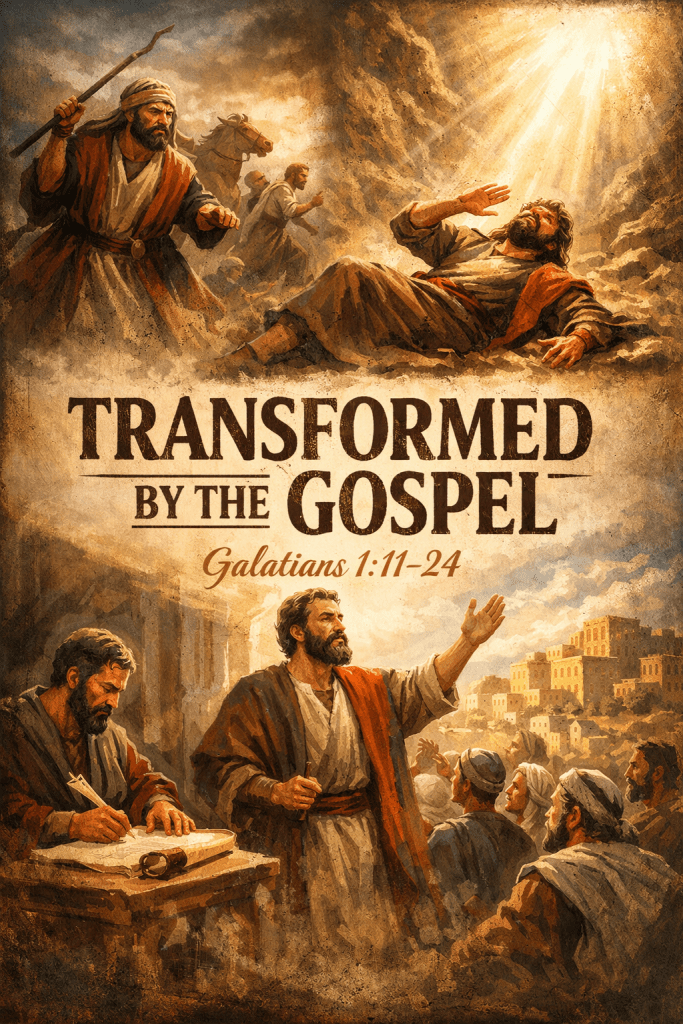
God’s Amazing Grace
Churches often ask members to share their testimony in a service or prayer meeting, and here we find the apostle Paul sharing his. In fact, Galatians 1:10-2:21 is often called the autobiographical section of the epistle, since Paul is recounting his conversion and early Christian experience. This is not a rare thing for Paul; we find him talking about his own conversion and experience in Acts 22:2-21 and 26:4-23. And here, as in Acts, Paul is not sharing his testimony for general inspiration, or to point us to himself. He’s using it to refute the claims of people who want to undermine his message, and he wants it all to point to the God of amazing grace.
Counter Claims
As Paul tells us how he became a follower of Jesus – or, perhaps more accurately, how Jesus made him His follower – he’s defending himself from three attacks “some people” (v.7) were making on him and his gospel message.
First, Paul refutes the idea that he came to his gospel message through his own reflection, reasoning and thinking. He recounts that, until his conversion, he was “intensely” hostile to the church and to Christianity (v.13). He wanted to “destroy it.” There was no gradual process of consideration, discussion, revision. There was no way that Paul’s Christian message was the product of his own line of thinking. Rather, it was the exact, polar opposite of where he had been going.
Pre-Christian Paul was so violently opposed to Christ that even watching the faith and certainty of Christian martyrs had no effect on him (Acts 7:54-8:1). His experience is strong evidence that his conversion was via direct revelation. As Acts 9:1-9 shows us, the risen Jesus met and instructed Paul directly. Paul did not have simply a trance or a dream. Christ was there in time and space, since even the other men with Paul recognized the presence (Acts 9:7). So Paul became a capital- A apostle, like those who were apostles before him (Gal. 1:17).
Second, Paul undermines the claim that his gospel message was derived from others, from Christian leaders in Jerusalem. “I did not consult any man, nor did I go up to Jerusalem to see those who were apostles before I was” (v.16-17). There were three years between Paul’s conversion and his first journey to Jerusalem (v.18-19), and even then he did not get instructed by them in any methodical way.
Paul’s repeated reference to the apostles at Jerusalem suggest that “some people” (v.7) were claiming that Paul had simply gotten his gospel message from this “headquarters”. This would enable them to argue: We have also been trained at the Jerusalem HQ. And we know that Paul did not give you the whole story. There are other things you must do in order to be pleasing to God.
Third, Paul shows that his God-given gospel “checked out” with the message the other apostles had received from God. Peter (v.18), James (v.19) and the church of Judea (v.22) were among those who “praised God” (v.24) for what He had done for Paul, and for the message He had given Paul. He did not receive his commission or message from the other apostles; but his message squared with the one the other apostles received from the risen Lord (Luke 24:45-49).
So Paul’s account eliminates claims like: That’ what Paul thinks – here’s what we think, and it’s just as valid; Paul’s message is fine, but incomplete; Paul’s message is simply the message – it’s not what the church teaches in Jerusalem.
But Paul’s testimony doesn’t only establish his authority as a gospel teacher. It also illustrates some aspects of what the gospel of grace is. You might think: We covered this in the previous blog post! And we did – but this letter, in its structure as well as its content, shows us that the gospel of grace underpins every step of the Christian life. Paul will keep coming back to it; so should we, on our lives, our prayers, our thoughts, our witness, our preaching and teaching.
Amazing Grace: You Paul Was
Paul was a man who had done many terrible things. He had “intensely…persecutd the church of God and tried to destroy it” (v.13). By the time Jesus met Paul on the Damascus road, he had killed many innocent people. He was on his way to arrest and imprison more. He was filled with hate.
And yet Paul was also a man who had done many religious deeds. He had spent years seeking to live according to the Jewish customs and traditions. He says that he had beaten almost everyone of his own generation (“of my own age”, v.14) at being zealous for moral righteousness (v.14). And yet it had not made him right with God.
Up until this point we have not been told the nature of the teaching of “some people” who were “trying to pervert the gospel” (v.7), but here is the first hint. Later we will see that they were encouraging the Gentile Christians to become full converts to Judaism, and to keep al the Mosaic laws of diet and dress, including circumcision (2:12; 3:5; 6:12). But Paul is saying: I’ve already been there and done that! I know all about this subject! You cannot make yourself acceptable to God by the most zealous and detailed following of moral, ethical, or cultural codes.
Before conversion, Paul was a great religious rule-keeper – and he knew it. He was filled with pride. And yet, despite all this, he was not only saved by Christ, but also called to be a preacher and leader to the beating heart of Christianity – the gospel of grace.
Grace is the free, unmerited favor of God, working powerfully on the mind and heart to change lives. There is no clearer example than Paul that salvation is by grace alone, not through our moral or religious performance. Though Paul’s sins were very deep, he was invited in.
Paul’s experience proves vividly that the gospel is not simply “religion” as t is generally understood. The gospel calls us out of religion as much as it calls us out of irreligion.
No one is so good that they don’t need the grace of the gospel, nor so bad that they can’t receive the grace of the gospel. Paul was deeply flawed, yet he could be reached with the gospel. As C.S. Lewis once said, “Christianity must be from God, for who else could have thought it up?”
Amazing Grace: What God was Doing
As he looks back, Paul can now recognize that God’s sovereign grace was working in his life long before his actual conversion. When Paul says God “set me apart from birth,” (v.15) he means that the grace of God had been shaping and preparing him all his life for the things God was going to call him to do.
This is astonishing. Paul had been resisting God and doing so much wrong (Acts 26:14), but God was overruling all his intentions and using his experiences and even his failures to prepare him first for his conversion, and then to be a preacher to the Gentiles (v.16). The Old Testament knowledge; the zeal; the training; the effort he was using to oppose God and his church (v.13) – all were being used by God to break him and to equip him to be God’s instrument for building His church. God had been working all along to use Paul to establish the very faith he had opposed (v.23).
This is a major theme in the Bible. Back in Genesis, Jospeh told his brothers that their very effort to reject him as God’s chosen deliverer – in which they had gone so far as to try to kill him, and had then successfully sold him as a slave (Genesis 37:5-8, 19-20) – had actually been the means to establish Joseph as that deliverer (Genesis 50:19-20). The apostles insisted that the people who tried to oppose Jesus only served to further God’s purposes (Acts 2:23; 4:27-28). All opposition to God will be seen in the end as having done nothing but confirm and further His design.
In chapter 9 of his spiritual autobiography, Surprised by Joy, C.S. Lewis tells of his schoolteacher, Kirkpatrick. Nicknamed “The Great Knock”, he was a furious debater and logician who taught Lewis how to build a case and make strong arguments. Kirkpatrick was an atheist, and he intended to strengthen Lewis in his own unbelief. But years later, when Lewis became a Christian, it turned out that “The Great Knock” had trained him well to become one of the greatest defenders of the Christian faith in the 20th century.
The gospel give us a pair of spectacles through which we an review our own lives and see God preparing us and shaping us, even through our own failures and sins, to become vessels of His grace in the world.
So why did all this happen? Why did God choose, prepare, and then call Paul, the proud persecutor of His church? Was it because Paul was in some way, in any way, pleasing to God? No, it was simply because God “was pleased” to do so (v.15). God set his loving grace on Paul not because he was worthy of it, but simply because God took delight or pleasure in doing so. This is ow God has always worked. As Moses tells God’s people Israel in Deuteronomy 7:7-8: “The Lord did not set his affection on you and choose you because you were more numerous than other peoples, for you were the fewest of all peoples. But it was because the Lord loved you.”
God does not love us because we are serviceable; He loves us simply because He loves us. This is the only kind of love we can ever be secure in, of course, since it is the only kind of love we cannot possibly lose. This is grace.
Amazing Grace: What God is Doing (Part 2)
The God of grace saves sinners like Paul. He reveals His risen Son to both the proud and the evil – the religious and the irreligious. And He’s at work in His people even before He saves them, to bring them to faith and to equip them to serve Him.
But that is not where grace finishes its work. Grace has continued to work in and through Paul. The apostle testifies not only of who he was, and how God converted Him, but also of what a life lived under God’s grace looks like.
First, we read that God was pleased “to reveal his Son in me, so that I might preach” (v.16). What Paul means here is not immediately clear. What does it mean that God revealed Jesus “in” Paul? The interpretation is that Paul is combining two experiences in one. On the one hand, God obviously revealed Jesus to Paul on the road to Damascus. There Paul finally realized who Jesus was. He had a personal encounter with the living Christ. But secondly, (as the rest of v.16 shows), Paul immediately realized that he was being called to show others who Jesus was. So, we can say that God revealed Christ to Paul so that He could reveal Christ through Paul.
Second, we see something of Paul’s own path of growth and discipleship. He had solitary time with God. During his three years in Arabia (v.17-18), we assume he learned from God much that he later taught. Though we should not think that his time in Arabia was spent simply in solitude (there were thriving cities there), we do learn about the importance of study and reflection and the development of our own personal acquaintance with God. We live in a time that puts too much emphasis on activity and accomplishment, and not enough on reflection and contemplation.
This reference to Arabia is unique in the New Testament. And if we press the word “immediately” (v.17) too literally, it seems to conflict with Acts 9:19-22, where Paul did some synagogue preaching immediately after his baptism. But Paul’s point here is that he went to Arabia, rather than Jerusalem, for his first sustained time of reflection and preparation.
Solitary time with God is fundamental to the Christian life; but the Christian life is not a solitary one. Paul went up to Jerusalem n for instruction, but for both accountability and unity (v.18). Even Paul must work on unity with the other apostles and must demonstrate that his message squares with theirs. How much more do we have the same responsibility? We too must be deeply rooted in church communities. We have to avoid picking what we need here and there without ever becoming grafted into a cohesive community of other believers.
Such a Christian life, rooted in relationship with God through Christ, and in unity with and service of other believers, leads to praise of God. The Christians in Jerusalem “praised God because of me,” says Paul (v.24). The change in Paul’s life and hi service to others did not lead people to lionize Paul, but to love God.
Paul’s Testimony, and Ours
Paul does not share his testimony out of habit, nor for general inspirational purposes, nor because he enjoys putting a spotlight on his personal experiences. He only shares his testimony because he believes it will helps his hearers find Christ and encourage them not to lose Him (v.6). He has no desire for attention or acclaim. He is completely focused on the listeners. He is not using his hearers to boost his ego, but using his testimony to help his friends.
Paul is a good example to us here. He shows us that we must have the courage to be vulnerable and speak personally about what the gospel means to us. Why? Because Christianity is an appeal to bring our whole life, mind and heart, to Christ. To leave out how we think, or how we feel, is to give an incomplete picture of how comprehensive Christian commitment is. If we leave out our testimony, it also gives an incomplete picture of how complete Christian fulfillment is. Christ not only appeals to our minds, He fills our hearts. Different cultures and personalities have different emphases on the cognitive (head-understanding) and the experiential (heart-feeling). If you leave out your testimony, the more heart-focused cultures and temperaments will not see the attractiveness of Christianity.
At the same time, Paul also reminds us that we must only share our testimony if it is helpful to others. Strange as it may sound, it is very easy to use our testimony in a way that clouds the gospel.
If we emphasize dramatic, gory, or sexual details, we may only be sending the message: Look at what an amazing case I am! Paul gets personal only to make the gospel clear. We are not sharing our story for ourselves, but to help others understand and find Christ; to point others to the amazing gospel of grace which has changed our lives, and which we know can change theirs, too.
The Uniqueness of the Gospel (Galatians 1:1-10)
Perhaps the most striking aspect of the opening of Galatians is Paul’s tone, and the frame of mind that lies behind it. He is surprised. And he also seems angry. His language, almost from the outset, is remarkably strong. Where normally Paul’s letters move on, after his greeting, to a thanksgiving for those he’s writing to, here he simply says, “I am astonished…(verse 6a). What has made Paul so emotional?
Desertion
First, Paul is astonished because these young Christians are taking hold of a “gospel” that isn’t really a gospel (v7), so they are in enormous danger. They are in confusion (7b).
Second, he is directly angry at the ones who are misleading the converts of the church – those who are “trying to pervert the gospel” (v7b). He calls down condemnation on them (v9). More indirectly, he is also angry at the Galatian Christians themselves, warning them that they are deserting the God who called them (v6b) – a serious charge!
We’ll see as we walk through Paul’s letter that what caused his opening outburst was a group of teachers who were teaching Gentile Christian converts that they were obliged to keep the Jewish cultural customs of the Mosaic Law – the dietary laws, circumcision and the rest of the ceremonial law in order to be truly pleasing to God. To the Galatians, this probably didn’t appear to be a radical difference from what they’d been taught. Surely the whole point of the Christian life is to be pleasing to God! But Paul says, “This is an absolute repudiation of all that I have been telling you.
He is not puling his punches! But if we believe what Paul believed about the gospel, then we will find his attitude justifiable. If the Galatians are really turning their backs on God and taking hold of a gospel that isn’t a gospel at all, then their condition is dangerous. The anxiety and anger that Paul expresses is the same that any loving parent or friend would experience if a child or companion was going seriously astray.
Paul’s Right to Speak
But who is Paul to write to these Christians in this way?
An “apostle” (v.1) – a man who has been sent with immediate divine authority. The Greek word apostolos means to be “sent”. Paul’s phrase “not from men nor by a man” drives home the uniqueness of the first apostles. Those who are called to ministry by the Holy Spirit today are not “from men” either – the ultimate cause of their ministry is Jesus’ call, and the ultimate authority for their ministry is Jesus’ word in the Bible. But they are appointed “by man”. (The Greek word here – dia – means “by” or “through”, as in our word “diameter”). This means that though ministers ultimately receive their call from God, they are called through the intermediaries of other human ministers, or through the election of a congregation, and so on.
Paul is claiming something more than this for himself. He is saying that he did not receive his apostolic commission through anyone else at all. No other apostles commissioned him. He was commissioned and taught directly by the risen Jesus Himself (see Acts 9:1-19).
Second, in verses 8-9, Paul says he was sent with a particular divine message – the gospel. This means his divine teaching is the standard for judging who is orthodox and who is heretical, as he says in verse 9, “if anybody is preaching to you a gospel other than what you accepted, let him be eternally condemned!” Even an apostle cannot alter, revise or add to the message of Christ. What he says is not the result of his study, research, reflection and wisdom. It is God-given, and both unchanging and unchangeable.
We might wonder: are there any more apostles today? Not in the full way of Paul and the Twelve. In the early church, others were called “apostles of the churches” (for example 2 Corinthians 9:3). Barnabas was “sent” to Antioch, and in that sense was an “apostle” (Acts 11:22, and see also Acts 14:14). However, while they were sent out as missionaries, they were commissioned by the other, original apostles or by the churches – “by man”. Barnabas never met the risen Christ; he was never taught and tutored in the gospel by the bodily-present Christ, as Paul and the Twelve were. So we can call people who have unusual leadership gifts, then and now, “small-a” apostles. But Paul is a “capital-A” Apostle, commissioned directly by Jesus. The “capital-A” Apostles had, and have, absolute authority. What they write in Scripture.
What is the Gospel?
And so this divinely appointed Apostle reminds the Galatian Christians of his particular divine message – the gospel. In his opening, he gives them a quick, yet pretty comprehensive, outline of the gospel message:
Who we are: Helpless and lost. That is what the word “rescue” implies in verse 4. Other founders of religions came to teach, not to rescue. Jesus was a great teacher, but when Paul gives us this nutshell version of Jesus’ ministry, he makes no mention of that at all. The average person on the street believes that a Christian is someone who follows Christ’s teaching and example. But Paul implies that’s impossible. After all, you don’t rescue people unless they are in a lost state and a helpless condition! Imagine you see a drowning woman. It doesn’t help her at all if you throw her a manual on how to swim. You don’t throw her some teaching – you throw her a rope. And Jesus is not so much a teacher as He is a rescuer. Because that’s what we most need. Nothing in who we are or what we do saves us. This is what theologians call “spiritual inability.”
What Jesus did: How did Jesus rescue us? He “gave himself for our sins” (v. 4a). He made a sacrifice which was substitutionary in nature. The word “for” means “on behalf of” or “in place of.” Substitution is why the gospel is so revolutionary. Christ’s death was not just a general sacrifice, but a substitionary one. He did not merely buy us a “second chance”, giving us another opportunity to get life right and stay right with God. He did all we needed paid for our sins on behalf, we can never fall back in condemnation. Why? Because God would then be getting two payments for the same sin, which is unjust! Jesus did all we should have done, in our place, so when He becomes our Savior, we are absolutely free from penalty or condemnation.
What the Father did: God accepted the work of Christ on our behalf by raising Him “from the dead” (v.1) and by giving us the “grace and peace” (v3) that Christ won and achieved for us.
Why God did it: This was all done out of grace – not because of anything we have done, but “according to the will of our God and Father” (4d). We did not ask for rescue, but God in His grace planned what we didn’t realize we needed, and Christ by His grace (v.6) came to achieve the rescue we could never have achieved ourselves.
There is no indication of any other motivation or cause for Christ’s mission except the will of God. There is nothing in us which merits it. Salvation is sheer grace.
That is why the only one who gets “glory for ever” is God alone (v.5). If we contributed to our rescue…if we had rescued ourselves…or if God had seen something deserving of rescue, or useful for His plan, in us…or even if we had simply called out for rescue based on our own reasoning and understanding…then we could pat ourselves on the back for the part we played in saving ourselves.
But the biblical gospel – Paul’s gospel – is clear that salvation, from first to last, is God’s doing. It is His calling; His plan; His action; His work. And so it is He who deserves all the glory, for all time.
This is the humbling truth that lies at the heart of Christianity. We love to be our own saviors. Our hearts love to manufacture glory for themselves. So we find messages of self-salvation extremely attractive, whether they are religious (keep these rules and you earn eternal blessing) or secular (grab hold of these things and you’ll experience blessing now). The gospel comes and turns them all upside down. It says: You are in such a hopeless position that you need a rescue that has nothing to do with you at all. And then it says: God in Jesus provides a rescue which gives you far more than any false salvation your heart may love to chase.
Paul reminds us that in the gospel we are both brought lower and raised higher than we can imagine. And the glory for that, rightly, all goes to “our God and Father…for ever and ever. Amen (v.5).
Questions for Reflection
- Paul’s tone reminds us that Christian faith is a matter of heart, as well as head – feelings, as well as intellect. How does this encourage you? How does it challenge you?
- When do you find it hardest to accept the authority of apostolic New Testament teaching? Why?
- How would you explain the gospel to someone who asked you today what you believe?
Gospel Revision – Gospel Reversal
The biblical gospel of grace is a precious thing. And it’s this glorious gospel that the Galatian churches’ leaders have been perverting, and that the Galatian church members have been deserting.
This matters because Paul says that any such change to the gospel means it becomes “no gospel at all” (v.7). Why is this? Why is it that any change to the gospel, however small, makes it null and void?
Because, Paul says, Christians were “called…by the grace of Christ” (v.6). God called us; we didn’t call Him. And God accepted us right away despite our lack of merit. That is the order of the gospel. God accepts us, and then we follow Him. But other religious systems have it the other way around. We must give God something, and then He accepts us. So in verse 7, Paul says that any teaching which adds keeping Mosaic ceremonial law to faith in Christ “perverts” the gospel. Literally, the word he chooses to use means “reverses.”
This is illuminating. If you add anything to Christ as a requirement for acceptance with God – if you start to say: To be saved I need the grace of Christ plus something else – you completely reverse the “order” of the gospel and make it null and void. Any revision of the gospel reverses it. That is why in verse 6 Paul says that the false teachers are producing a “different gospel”, which he quickly qualifies in verse 7 as “really no gospel at all.” Literally, Paul says: “another gospel, which is not another.”
This is crystal clear. Another gospel is not another gospel. It is no gospel. To change the gospel the tiniest bit is to lose it so completely that the new teaching has no right to be called a “gospel.” The sixteenth-century Reformer Martin Luther summed it up well:
“There is no middle ground between Christian righteousness and works-righteousness. There is no other alternative to Christian righteousness but works righteousness, if you do not build your confidence on the work of Christ you must build your confidence on your own work.”
Losing the Gospel Today
What Paul battled in his day, and Luther fought against in his, we witness in ours, too. Remember, Paul condemns any teaching that is not based on the fact that:
- We are too sinful to contribute to our salvation (we need a complete rescue).
- We are saved by belief in Jesus’ work – the “grace of Christ” – plus nothing else.
Here are three examples of current views that deny one or both of these two truths:
- In some churches, it is implicitly or explicitly taught that you are saved through your surrender to Christ, plus right beliefs and behavior. This is a fairly typical mistake in evangelical churches. People are challenged to “give your life to Jesus” and/or to “ask Him into your life.” This sounds very biblical, but it still can reject the grace-first principal fairly easily. People think that we are saved by a strong belief and trust in and love for God, along with a life committed to Him. Therefore, they feel they must begin by generating a high degree of spiritual sorrow, hunger, and love in order to get Christ’s presence. Then they must somehow maintain this if they are going to “stay saved.” So functionally – that is, in actual reality – a church is teaching the idea that we are saved because of the level of our faith. But the gospel says that we are saved through our faith. The first approach really makes our performance the savior, and the second makes Christ’s performance the Savior. It is not the level but the object of our faith that saves us.
- In other churches, it is taught that it doesn’t really matter what you believe as long as you are loving and good person. This is a typical mistake in “liberal” churches. This view teaching that all good people, regardless of their religion (or lack of one), will find God. This sound extremely open-minded on the surface, but it is actually intolerant of grace, in two ways.
First, it teaches that good works are enough to get to God. If all good people can know God, then Jesus’ death was not necessary; all it takes is virtue. The trouble is, this means bad people have no hope, contradicting the gospel, which invites “both good and bad” to God’s feast (Matt. 22:10). If you say people are saved by being good, then only “the good” can come in to God’s feast. The gospel offer becomes exclusive, not inclusive.
Second, it encourages people to think that if they are tolerant and open, they are pleasing to God. They don’t need grace – they get eternal life for themselves. And so “glory for ever” (v.5) goes to them, for being good enough for heaven. The gospel, however challenges people to see their radical sin. Without that sense of one’s own evil, the knowledge of God’s grace will not be transforming, and we will not understand how much God is glorified by the presence of anyone at all in heaven.
- A third example is found in churches that are extremely intolerant of small differences of dress or custom. The false teachers of Galatia wanted (as we will see) to impose many old rules and regulations having to do with dress, diet and ritual observances. It is natural for us to associate them with highly regulated churches and religious communities which control their members very tightly and direct them into the “right” way to eat, dress, date, schedule their time, and so on. Or they may insist on a detailed observance of many complicated rituals. Modern-day examples of the Galatian church would be highly authoritarian churches or highly ritualized churches, highly legalistic churches. To my mind, these churches are the most obvious of the three examples we’ve looked at, and therefore less dangerous. The first and second are much more prevalent, and perilous.
Is our Gospel the True Gospel?
Since the one true gospel is so crucial, and so often and easily reversed, this awakens in us a troubling question: how can we ensure the gospel we believe is actually true? How do we know it is not merely a gospel that we feel is true, or are told is true, or think is true, or sounds to us as true – but a gospel that is true, objectively, and therefore can save, really and eternally?
Paul lays down, in the strongest possible language, a plumb line for judging all truth claims, whether external (from teachers, writers, thinkers, preachers) or internal (feelings, sensations, experience). That standard is the gospel that he (and all the other capital-A Apostles) received from Christ and taught, and which is found in this letter and throughout the rest of the Bible.
“If we…should preach a gospel other than the one…let him be eternally condemned” (v.8). Here is how to judge external authorities such as human teachers, or human institutional leaders, or even ordained officers in a church hierarchy.
It is remarkable that by saying “we”, Paul includes himself as a human authority. He is saying that he must be rejected if he ever says: I’ve changed my mind about what the gospel is. As he’ll tell us, the gospel did not come to him through a process of reasoning and reflection, it was received, not arrived at. So he is not free to alter it through reasoning and reflecting. In Galatians 2, Paul will tell us that his gospel was confirmed by others who had also gotten the message by revelation from the risen Christ. This apostolic consensus – this original Christ-given “gospel deposit” – is therefore the touchstone for judging all truth claims, from the outside and the inside.
This is very important. Paul is saying in verse 8 that even his apostolic authority derives the gospel’s authority, not the other way around. Paul is telling the Galatians to evaluate and judge both him as an apostle and his teaching with the biblical gospel. The Bible judges the church; the church does not judge the Bible. The Bible is the foundation for and the creator of the church; the church is not the foundation for or creator of the Bible. The church and its hierarchy must be evaluated by the believer with the biblical gospel as the touchstone or plumb line for judging all truth claims.
Nor is the final plumb line for truth our personal experience. We do not judge the Bible by our feelings or convictions; we judge our experiences by the Bible. That means that if an angel literally showed up before a crowd of people and taught that salvation was by good works (or anything except faith alone in Christ alone), you should literally kick the angel out (v. 8)! When Paul says, “If we or an angel…,” he gives a sweeping summary of proper Christian “epistemology” – how we know what is true.
Why it Matters
We noticed at the start of this article (episode) that Paul’s tone is uncompromising, to say the least! But that’s because the gospel is something we need to be uncompromising about. That’s because, first, a different gospel means you are deserting the one who called you (v.6). To abandon gospel theology is to abandon Christ personally. What you do in theology eventually affects your experience. In other words, a difference in your understanding of doctrine leads to a difference in your understanding of who Jesus is – and means it’s questionable whether you really know Him at all.
Second, a different gospel is no gospel at all (v.6-7). This means that the gospel message, by its very nature, cannot be changed even slightly without being lost. It’s like a vacuum. You can’t allow in some air and say that it is now a “90 percent vacuum” or an “air-enriched vacuum.” It is either a complete vacuum or no vacuum at all! Equally, the message of the gospel is that you are saved by grace through Christ’s work and nothing else at all. As soon as you add anything to it, you have lost it entirely. The moment you revise it, you reverse it.
Third, a different gospel brings condemnation (v.8-9). Later in the book Paul says that different “gospels” bring a curse with them. This means, ultimately, that to alter the gospel is to play with eternal life and death. But it also means very practically that fear, anxiety and guilt (the sense of condemnation and curse) will always be attached to different “gospels” even in this life. As we will see later in the book, even Christians sometimes experience a sense of condemnation. When they do, it is because, functionally, they are trusting in different “gospels”, different ways to earn salvation. The “present evil age” (v.4) can still influence believers.
Now we can see why Paul adopts such intense and even severe language. The stakes are high – our knowledge of Christ, the truth of the gospel, and the enteral destiny of people’s souls. These are the things worth fighting for; worth speaking out over; worth reminding ourselves and others of over and over again. Paul’s bluntness is loving. He is a capital-A Apostle who loves the Lord, the Lord’s gospel, and the Lord’s people. If we love as he did, we’ll understand why he wrote as he did – and be grateful that he did.
Questions for Reflection
- How important is gospel truth to you? How is this shown in your life?
- Why will understanding the true gospel produce anger at false “gospels”?
- Which of the three modern false-gospel dangers could you or your church mostly easily fall for?
When Jesus Arrives
Come Out of the Grave
The moment has come. Jesus stands before the tomb and says: “Take away the stone.” Martha hesitates. “Lord… by this time there is a bad odor…”
Translation: It’s too far gone.
But Jesus responds: “Did I not tell you that if you believe, you will see the glory of God?” Then He calls out: “Lazarus, come out!” And the dead man walks. Still wrapped. Still bound. But alive. And Jesus says: “Take off the grave clothes and let him go.” This is resurrection. Not just for Lazarus—but for all of us. Because Jesus still calls people out of graves. Graves of sin. Graves of shame. Graves of fear. Graves of hopelessness. And when He calls—you come alive.

When Jesus Arrives
Jesus Wept
Shortest verse. Deepest truth. “Jesus wept.” He knew what He was about to do. He knew resurrection was coming. And still—He wept. Why? Because Jesus is not distant from our pain. He enters it. He feels it. He shares it. This is not a detached Savior. This is a compassionate one. He doesn’t rush past grief to get to the miracle. He pauses. He mourns. He stands with those who are hurting. And that means this: You are never alone in your sorrow. Jesus doesn’t just fix brokenness. He sits with you in it.

When Jesus Arrives
When Grief Meets Jesus
Martha meets Jesus with both faith and frustration: “Lord, if you had been here…” Have you ever prayed something like that?
If You had shown up…
If You had answered…
If You had intervened…
Martha believes—but she’s hurting. And Jesus doesn’t rebuke her. He meets her. Then He makes one of the most powerful declarations in Scripture: “I am the resurrection and the life.” Not I will be. Not I can bring. But I am. Resurrection is not just an event. It is a person. Hope is not a concept. It is Jesus Himself. Even before Lazarus walks out of the tomb,
Jesus invites Martha into deeper faith. Not just belief in what He can do— but trust in who He is.

When Jesus Arrives
Walking without Fear
Jesus finally moves—but not toward safety. Toward danger. The disciples are confused:
“Rabbi, they were just trying to stone you…”
In other words:
Why go back there?
And Jesus responds with a powerful image:
“Are there not twelve hours of daylight?” In essence, He is saying: When you walk in the will of God, you walk in the light of God. Jesus is not reckless. He is resolved. He is not controlled by fear—He is guided by the Father. And that’s the difference. Fear asks: What might happen to me? Faith asks: What is God calling me to do?
Thomas—often remembered for doubt—actually shines here: “Let us also go, that we may die with him.” It’s raw. It’s honest. But it’s also courageous.
Following Jesus doesn’t always lead to comfort. Sometimes it leads straight into uncertainty. But here’s the promise: When you walk in obedience, you are never walking alone.
When Jesus Arrives
When God Delays
Text: John 11:1–6
There is something deeply unsettling about this passage. “Lord, the one you love is sick.” And then… nothing. No urgency. No immediate response. No miracle on demand. Instead, John tells us something almost jarring:
“So when he heard that Lazarus was sick, he stayed where he was two more days.”
Jesus delays.
And not because He doesn’t care—but because He does. That’s the tension. We often interpret delay as absence. We assume silence means indifference. We conclude that if God loved us, He would act faster.
But this passage dismantles that assumption. Jesus’ delay is not neglect—it is intentional.
He says in verse 4: “This sickness will not end in death. No, it is for God’s glory…”
What if the delay in your life is not denial—but design? What if Jesus is doing something deeper than what you can see? Mary and Martha wanted healing. Jesus planned resurrection. They wanted relief. Jesus was preparing revelation. And here’s the hard truth: Sometimes Jesus allows a situation to move beyond fixing…so that He can reveal something greater. We want a quick answer. Jesus wants a deeper transformation. We want the pain to stop. Jesus wants faith to grow. Delay does not mean Jesus is distant. It means He is working on a different timeline. And His timeline is always anchored in love—even when it doesn’t feel like it.
Living and Loving Like Jesus
Sent into the World
Scripture
“As the Father has sent me, I am sending you.”
— John 20:21
The Mission Continues
After His resurrection, Jesus appeared to His disciples and spoke these powerful words. “As the Father has sent me, I am sending you.” With that statement, Jesus entrusted His followers with a mission. The work He began would now continue through them. And that mission continues today.
Everyday Mission Fields
Many people imagine mission as something that happens far away. But the truth is that God places His people in everyday mission fields. Our homes. Our workplaces. Our communities. Our friendships. These are the places where we reflect the love of Christ. Every act of kindness. Every word of encouragement. Every moment of integrity. All of these point people toward the grace of God.
Living as Ambassadors of Christ
The apostle Paul later described believers as ambassadors for Christ.
An ambassador represents the values and message of the one who sent them. In the same way, followers of Jesus represent His kingdom wherever they go. When we live with love, humility, compassion, and faith, people begin to see the character of Christ through us.
Reflection Questions
- Where has God placed you to influence others?
- Who around you might need to experience the love of Christ?
- How can your daily life reflect the mission of Jesus?
Closing Prayer
Lord Jesus,
Thank you for inviting us to participate in your mission. Help us live faithfully wherever you have placed us. May our lives reflect your love and truth so that others may come to know you.
Amen.
Living and Loving Like Jesus
Surrendering to the Father
Scripture
“Father, if you are willing, take this cup from me; yet not my will, but yours be done.”
— Luke 22:42
The Prayer of Surrender
In the quiet garden of Gethsemane, Jesus prayed one of the most profound prayers in Scripture. He knew the suffering that lay ahead. He knew the cross was coming. And yet His prayer revealed complete trust in the Father. “Not my will, but yours be done.” These words capture the essence of surrender.
Trusting God in Difficult Moments
Surrender does not mean pretending that life is easy. Jesus was honest about His anguish. But even in that moment of deep struggle, He trusted the Father’s plan. Following Jesus means learning to trust God in the same way. Sometimes God leads us through seasons we do not fully understand. Moments of uncertainty. Moments of difficulty. Moments when the path ahead seems unclear. In those moments, the prayer of Jesus becomes our prayer. “Your will be done.”
The Freedom of Surrender
At first, surrender may seem like loss. We release control. We let go of our plans. But in reality, surrender leads to freedom. When we trust God with our lives, we discover peace that does not depend on circumstances. We find assurance that the Father’s purposes are good. Jesus’ surrender in Gethsemane ultimately led to the resurrection. God’s plans are always greater than what we can see.
Reflection Questions
- Is there an area of your life where God is inviting you to trust Him more deeply?
- What does surrender to God look like in your current season?
- How might the prayer of Jesus shape your own prayers?
Closing Prayer
Father,
Teach us to trust you the way Jesus trusted you. Help us surrender our plans, fears, and uncertainties into your hands. Strengthen our faith so we may walk in obedience and peace.
Amen.
Living and Loving Like Jesus
The Compassion of Jesus
Scripture
“When he saw the crowds, he had compassion on them, because they were harassed and helpless, like sheep without a shepherd.”
— Matthew 9:36
Seeing People the Way Jesus Saw Them
One of the most striking characteristics of Jesus in the Gospels is His compassion. Again and again we read the phrase: “He had compassion.” Jesus was not distant or indifferent toward human suffering. He was deeply moved by it. When He saw the crowds, He did not see a nuisance or an interruption. He saw people who were hurting. People searching for hope. People longing for guidance. Matthew describes them as “harassed and helpless, like sheep without a shepherd.” This imagery reflects a profound spiritual reality. Without God’s guidance, people wander through life searching for meaning, belonging, and peace. And Jesus responded with compassion.
Compassion That Moves Toward People
The compassion of Jesus was not passive. It always moved Him to action. When He saw the sick, He healed them. When He saw the hungry, He fed them. When He encountered the brokenhearted, He spoke words of hope. His compassion reached across social boundaries. He touched lepers. He forgave sinners. He welcomed outsiders. In a world often defined by exclusion, Jesus consistently moved toward those who were pushed aside.
The Power of Being Seen
Sometimes compassion begins with something very simple: noticing people. In our busy world, it is easy to overlook those around us. We pass people every day without truly seeing them. But Jesus noticed people. He noticed the blind man sitting by the roadside. He noticed the woman who had been suffering for twelve years. He noticed Zacchaeus in the tree. When people encountered Jesus, they experienced something powerful. They felt seen. They felt valued. They felt loved.
Compassion in Everyday Life
Living like Jesus means cultivating that same awareness. It means slowing down enough to see people. The coworker who seems unusually quiet. The neighbor who lives alone. The friend who seems discouraged. Compassion invites us to move toward others with kindness and empathy. Sometimes that means offering practical help. Other times it means simply listening. Either way, compassion reflects the heart of Christ.
Reflection Questions
- Who around you might be feeling overlooked or discouraged?
- How can you show compassion in a tangible way this week?
- What would it mean to see people through the eyes of Jesus?
Closing Prayer
Lord,
Give us hearts that reflect your compassion. Help us see people the way you see them and respond with love. May our lives become channels of your grace to those who are hurting.
Amen.
Living and Loving Like Jesus
The Servant King
Scripture
“For even the Son of Man did not come to be served, but to serve, and to give his life as a ransom for many.”
— Mark 10:45
A Different Kind of King
Every culture has its own definition of greatness. In many places, greatness is measured by influence, wealth, or authority. Leaders rise to positions of prominence, and others serve them. Power flows downward from the top. But when Jesus came announcing the kingdom of God, He introduced a completely different vision of greatness. The King of heaven did not arrive surrounded by royal guards or seated on a throne of gold. Instead, He walked dusty roads with fishermen, tax collectors, and ordinary people. He touched lepers. He spoke with outcasts. He spent time with children. And when His disciples began arguing about which of them was the greatest, Jesus responded with words that turned their assumptions upside down. “The Son of Man did not come to be served, but to serve.” The King became a servant.
The Kingdom’s Definition of Greatness
Earlier in the same passage, Jesus explained to His disciples that the rulers of the Gentiles “lord it over” those under their authority. In other words, worldly leadership often centers on control and status. But Jesus said the kingdom of God operates differently. “Whoever wants to become great among you must be your servant.” (Mark 10:43). In God’s kingdom, greatness is measured not by how many people serve you—but by how many people you serve. Jesus did not merely teach this principle. He embodied it. His entire life was a demonstration of humble service.
The Basin and the Towel
One of the most powerful illustrations of this truth appears in John 13. On the night before the crucifixion, Jesus and His disciples gathered for the Passover meal. In that culture, washing the dust from someone’s feet was the job of a servant. Yet no servant was present that evening. The disciples likely noticed the basin and towel sitting nearby, but none of them stepped forward. Then something astonishing happened. Jesus stood up from the table, wrapped a towel around His waist, poured water into the basin, and began washing the disciples’ feet. The Creator of the universe knelt before His followers. One by one, He washed their feet. Imagine the silence in that room. The disciples must have been stunned. Even Peter initially resisted, saying, “You shall never wash my feet.” But Jesus insisted. Afterward, He explained the meaning of the moment. “I have set you an example that you should do as I have done for you.” (John 13:15). Jesus was showing them—and us—that leadership in the kingdom of God is expressed through humble service.
Service That Reflects the Heart of Christ
When we think about serving others, it is easy to imagine dramatic acts of sacrifice. But often, service looks much simpler. It happens in everyday moments. Helping someone who is struggling. Encouraging someone who feels discouraged. Offering practical help without being asked. Listening patiently when someone needs to talk. These acts may seem small, but they carry great significance. They reflect the heart of Christ. Jesus did not seek recognition for His service. He simply loved people in tangible ways.
A Quiet Example of Servant Leadership
A well-known Christian leader once shared a story about a janitor at a church he attended as a young man. Every Sunday morning, the janitor arrived before anyone else. He quietly prepared the building—cleaning floors, arranging chairs, and making sure everything was ready. Most people never noticed his work. One day someone asked him why he was so committed to a task that few people appreciated. The man smiled and said, “I’m not just cleaning a building. I’m preparing a place where people will meet with God.” His perspective transformed a simple task into an act of worship. That is the spirit of service Jesus invites us to embrace.
Serving Without Recognition
One of the challenges of serving others is that it often happens without recognition. There may be no applause. No public acknowledgment. But Jesus reminds us that the Father sees every act of love done in His name. Even the smallest gesture matters. In Matthew 25, Jesus describes how acts of kindness toward others are received as acts of kindness toward Him. When we serve someone who is hungry, lonely, or struggling, we are reflecting the love of Christ.
Becoming Servants Like Jesus
The life of Jesus invites us to rethink our priorities. Instead of asking, “How can I be recognized?” we begin asking, “How can I serve?” Instead of seeking status, we pursue humility. Instead of pursuing power, we pursue love. And when we serve others in the name of Christ, something remarkable happens. Our hearts begin to resemble His.
Reflection Questions
- Where might God be inviting you to serve others this week?
- Are there opportunities for quiet acts of service that often go unnoticed?
- How might humility reshape the way you lead or influence others?
Closing Prayer
Lord Jesus,
You showed us that greatness is found in humility and service. Help us lay aside pride and follow your example. Give us hearts that seek to lift others up and serve with joy.
May our lives reflect the humble love of Christ.
Amen.
Living and Loving Like Jesus
Love That Defines Us
Scripture
“A new command I give you: Love one another. As I have loved you, so you must love one another. By this everyone will know that you are my disciples, if you love one another.”
— John 13:34–35
The Defining Mark of a Disciple
If someone asked you how to recognize a follower of Jesus, how would you answer? Some might say it is belief in certain doctrines. Others might point to church attendance, prayer, or Bible study. All of those things are meaningful parts of the Christian life. But Jesus Himself gave a much simpler answer. The defining mark of His followers would be love.
On the night before His crucifixion, Jesus gathered His disciples for what we now call the Last Supper. The atmosphere must have been heavy with emotion. Within hours, everything would change. Jesus knew the cross was coming. His disciples did not yet understand what lay ahead. In that moment, Jesus gave them a command that would shape the identity of the Christian community for generations to come. “Love one another.” But Jesus did not stop there. He added words that raised the standard far beyond ordinary kindness. “As I have loved you, so you must love one another.” This was not merely a suggestion. It was a command. And it was not a vague concept of love either. Jesus defined the measure of love by pointing to His own life.
Love as I have loved you.
The Love of Jesus
To understand this command, we have to consider how Jesus actually loved people. When we read the Gospels, we see that the love of Jesus consistently crossed boundaries. Jesus loved people others ignored. He spoke with the Samaritan woman at the well, even though cultural expectations said He should not. He welcomed children when others thought they were a distraction. He healed lepers who had been pushed outside the community. He ate meals with tax collectors and sinners who had been rejected by religious society. Over and over again, Jesus moved toward people who had been overlooked. His love was not selective. It was not based on who deserved it. It was generous, gracious, and deeply personal. But the greatest expression of His love was still to come. Later that same evening, Jesus would leave the upper room and walk toward the garden of Gethsemane. Within hours, He would be arrested, mocked, beaten, and crucified. And He willingly walked that path. Why? Because of love. As the apostle Paul would later write, “God demonstrates his own love for us in this: While we were still sinners, Christ died for us.” (Romans 5:8)
The love of Jesus is sacrificial love. It gives rather than demands. It forgives rather than retaliates. It seeks the good of others even at personal cost. This is the love Jesus calls His followers to reflect.
Love as the Evidence of Faith
Jesus said something remarkable in John 13:35. “By this everyone will know that you are my disciples, if you love one another.”
Notice what He did not say. He did not say the world would recognize His followers by their theological knowledge. He did not say it would be their influence or religious activity. Instead, Jesus said the world would recognize His disciples by their love. Love is the evidence that Christ is truly shaping our lives. This kind of love is not always easy. It requires patience with difficult people. It requires forgiveness when we have been hurt. It requires humility when our pride wants to be right. But this love is also powerful. When Christians genuinely love one another, it becomes a living testimony to the presence of Christ in the world. The early church understood this well. Historians have noted that one of the things that astonished the Roman world about early Christians was the way they cared for one another and for the poor. Their love was visible. And people noticed.
A Story of Everyday Love
Years ago, a pastor shared a story about visiting a hospital late one evening. A member of his church had been seriously injured in an accident. When the pastor arrived at the hospital room, he discovered something unexpected. Several members of the church were already there. One person had brought food for the family. Another had been sitting quietly with the patient’s spouse for hours. Someone else had arranged childcare for the couple’s children. No one had asked them to do these things. There was no public recognition waiting for them. They simply showed up because someone in their community was hurting. The pastor later reflected on that moment and said, “That night I realized something. The world may not always listen to our sermons, but it notices our love.” That is exactly what Jesus meant. Love makes the gospel visible.
Living This Love Today
What does it look like to love like Jesus in everyday life? Often it begins with small, intentional actions. It may mean offering patience when someone is difficult. It may mean forgiving someone who has hurt you. It may mean showing kindness to someone who feels overlooked. Sometimes loving like Jesus means simply being present. Listening to someone who is struggling. Encouraging someone who feels discouraged. Serving someone who cannot repay the kindness. These moments may seem small, but they reflect the heart of Christ. The love of Jesus is not meant to remain an idea we admire. It is meant to become a way of life we practice.
Becoming People of Christlike Love
None of us loves perfectly. We all fall short of the love Jesus describes. But the good news of the gospel is that the same Jesus who commands us to love also transforms our hearts. As we walk with Him, pray, and remain rooted in His Word, the Spirit of God begins to shape our character. Gradually, we begin to reflect His patience. His kindness. His compassion. His grace. Over time, our lives begin to look more like His. And when that happens, something beautiful occurs. People begin to see Jesus in us.
Reflection Questions
- Who in your life might need to experience the love of Christ today?
- Is there someone you need to forgive or show grace toward?
- What practical step can you take today to love someone the way Jesus has loved you?
Closing Prayer
Lord Jesus,
Thank you for loving us with a love that is patient, gracious, and sacrificial. Teach us to love others the way you have loved us. Help us extend grace where it is needed, offer kindness where there is hurt, and serve others with humility. May our lives reflect your love so clearly that others see you through us. Amen.

A New Season of Calling
There are moments in the life of faith when the path ahead becomes clear only after a season of quiet listening. For many believers, discernment unfolds not through dramatic signs but through prayer, reflection, and a growing sense that God is gently guiding the next step. Recently, I have experienced such a season of discernment as I sought the Lord’s direction for the next chapter of ministry.
Throughout Scripture, God’s people often find themselves standing at these crossroads. Abraham was called to leave familiar ground and walk toward a promise he could not yet see. The disciples were invited by Jesus to leave their nets and follow Him into a life that would transform both them and the world around them. Again and again, the story of faith reminds us that God leads His people forward—sometimes into places of uncertainty, but always into deeper trust.
Over the past several months, that sense of calling has come through prayerful reflection and conversations about what faithful service might look like in this season of life. In those quiet moments of seeking the Lord’s will, a consistent theme has emerged: the call to shepherd, to teach, and to walk alongside others as we grow together in Christ.
Pastoral ministry has never been about standing above others with all the answers. Rather, it is about walking together as fellow travelers in the way of Christ. The church is a community of disciples learning, day by day, what it means to love God with heart, soul, mind, and strength, and to love our neighbors as ourselves. In this shared journey, pastors and congregations alike depend upon the guidance of the Holy Spirit.
The New Testament reminds us that Christ Himself is the true shepherd of the church. Human leaders are simply stewards of that greater work. The Apostle Peter wrote, “Be shepherds of God’s flock that is under your care… not pursuing dishonest gain, but eager to serve; not lording it over those entrusted to you, but being examples to the flock” (1 Peter 5:2–3). These words capture the heart of pastoral calling: a ministry rooted in humility, service, and love for God’s people.
As this new season begins, the central hope is simple but profound—that Christ would be lifted high and that lives would be shaped by His transforming grace. The mission of the church has always been the same: to proclaim the good news of Jesus Christ, to nurture disciples who grow in faith, and to serve the world with compassion and hope.
Every congregation carries a unique story of God’s faithfulness. Over the years, countless acts of prayer, generosity, perseverance, and love become part of the spiritual legacy of a church community. When we step into the life of a church, we step into that story—receiving what previous generations have faithfully built while seeking God’s direction for the future.
Yet the future of the church ultimately rests not in human plans but in God’s continuing work. The Apostle Paul reminds believers of this truth in Philippians 1:6:
“He who began a good work in you will carry it on to completion until the day of Christ Jesus.”
This promise offers deep encouragement. The same God who called the church into being continues to sustain and guide it. Seasons change, leadership changes, circumstances change—but the mission of God remains constant.
The prayer moving forward is that this next chapter of ministry will be marked by several things:
- Faithful proclamation of Scripture, allowing God’s Word to shape hearts and lives.
- Deepening discipleship, helping believers grow in maturity and spiritual formation.
- Authentic Christian community, where people are known, loved, and supported in their faith.
- Compassionate outreach, reflecting the love of Christ to the surrounding community.
When these elements take root, the church becomes more than an institution—it becomes a living testimony to the grace of God at work among His people.
In many ways, ministry is simply the ongoing work of pointing people toward Jesus. In worship, we lift our eyes to Him. In Scripture, we hear His voice. In fellowship, we experience His love through one another. And in service to others, we embody His compassion in the world.
Wherever the Lord leads His church in the years ahead, the prayer remains that Christ will be at the center. When Jesus is truly the focus of our worship, our teaching, our fellowship, and our mission, the church becomes what it was always meant to be—a community shaped by grace and sent into the world with hope.
May we continue to seek the Lord together, trusting that the One who calls is faithful, and that His purposes are always greater than anything we could imagine.
“And surely I am with you always, to the very end of the age.”
—Matthew 28:20

Living Letters – A New Podcast
Introducing the Living Letters Podcast: Faith Written on Hearts
We are excited to announce the launch of our brand-new podcast, Living Letters—a space where the words of Scripture move beyond the page and into the heart of everyday life. Inspired by 2 Corinthians 3:3, this podcast reminds us that God’s Word is not only read but lived. Each episode will explore the teachings of Jesus and the living truth of the Bible in ways that inspire, challenge, and encourage.
At Living Letters, our hope is simple: to discover together how the timeless words of Scripture continue to shape who we are and how we live. Whether you’re driving to work, walking through your neighborhood, or setting aside time with your Bible, we invite you to journey with us as we open God’s Word and find its relevance for today.
Why Living Letters?
It’s a story of faith, family, and formation—and it reminds us that God’s Word speaks into every stage of life, even the in-between seasons of waiting and growing.
The name comes from the Apostle Paul’s words in 2 Corinthians 3:3:
“You show that you are a letter from Christ… not written with ink but with the Spirit of the living God, not on tablets of stone but on tablets of human hearts.”
That’s the heartbeat of this podcast. We want to see Scripture come alive—not just as something studied, but as something lived. Every believer is a living letter testifying to the truth of Christ.
Sneak Peek: Episode One – The Day the Teachers Listened
In this episode, we’ll explore:
Our very first episode takes us to a remarkable moment in Jesus’ life: the story of the boy Jesus in the temple (Luke 2:41–52). At just twelve years old, Jesus astounded the teachers of the law with His wisdom and understanding. Yet this passage is not simply about His brilliance—it’s about identity, calling, and the deep relationship between a Son and His Father.
- What this passage teaches us about Jesus’ awareness of His mission.
- How Mary and Joseph’s response reflects our own struggles to understand God’s work.
- What it means for us today to “be about the Father’s business.”
Join Us on the Journey
The Living Letters podcast is now available on Spotify, Apple Podcasts, and other major platforms. Be sure to subscribe so you don’t miss an episode and share it with a friend who might need encouragement today.
We believe your life is more than ink on a page—it’s a Living Letter, written by the Spirit of God. Let’s read it together.

The Desire to Be Used by God
“For it is God who works in you to will and to act in order to fulfill his good purpose.” – Philippians 2:13
As we step into the fall season, there’s something refreshing about new beginnings. The air is crisp, the routines of summer give way to fresh rhythms, and many of us feel the pull to refocus our hearts. For followers of Jesus, this is an opportunity to once again lay our lives before Him and say, “Lord, here I am. Use me.”
At the center of that desire lies a beautiful truth: we are not left to our own strength or determination. Philippians 2:13 reminds us that God Himself is at work within us—shaping our will and empowering our actions so that His good purposes might be fulfilled through us. This means our longing to serve Him, to love others well, and to bring His light into our communities is not simply our idea—it’s His Spirit stirring within us.
Fall is more than just a change of season; it’s a reminder of God’s invitation to daily surrender. Just as the trees release their leaves, we are called to release our own plans, ambitions, and even fears, laying them at the feet of Jesus. In doing so, we make room for His purposes to flourish.
This new season is a chance to ask: How does God want to use me right where I am? Maybe it’s encouraging a neighbor, serving at church, mentoring someone younger in the faith, or simply being a steady presence of Christ’s love in your workplace. Whatever it looks like, our willingness to be used is matched by His promise to empower.
So, as we begin this fall, let us set aside time to pray:
“Lord Jesus, shape my heart. Stir my desires. Use me for Your glory. Let my life be a vessel of Your love in my community.”
When we surrender to God’s will, we discover the joy of being part of His story—a story that transforms us and blesses those around us. This fall, may our hearts echo the simple but powerful prayer: “Here I am, Lord. Send me.”
The Character of a Disciple – Week #12: Discerning His Voice
Bible Reading: John 14:16-17; John 18:37-38; Matthew 4:19
Discerning God and his voice come from being aligned with our Heavenly Father. For most, spiritual discernment is a mystery because they lack understanding of what Jesus promised his disciples (and us as followers today) when he left this earth.
John 14, verses 16-17 says,
I will ask the Father, and He will give you another Helper, so that He may be with you forever; the Helper is the Spirit of truth, whom the world cannot receive, because it does not see Him or know Him; but you know Him because He remains with you and will be in you.
Disciples, followers of Christ, are called to make other disciples. We can only accomplish this with help from the Holy Spirit. It is important to note that when we make our faith decisions, we are invited into the triune relationship of God the Father and God the Son by the indwelling of God the Holy Spirit. The Spirit speaks only the truth. Living every day aligned with Jesus brings about knowing his voice and learning his ways, the same as being raised by our parents, except the Holy Spirit will be with us forever (John 14:17).
The Holy Spirit speaks to us through the Bible as well. The Bible is God’s revelation of himself that we may know him and his purposes. Living with our family, we understand their moods, mannerisms, and motives because we are accustomed to them daily. The same is true of God. We will see the why of the gospel and God’s promises as we study his Word. We begin to recognize the voice of God and its prompting because of the Holy Spirit. I have a pastor friend that calls this a nudge from God.
God is nudging, who will you disciple?
REFLECTION
- How do you feel you are doing with listening to and discerning the voice of the Holy Spirit? Write down your answer with specific examples.
- What do you think God is nudging you to do today? What might stop you from being obedient?
PRAYER
Father, teach me to hear only your voice. Help me to filter out all others. Give me the courage to be obedient to your nudges. Amen.
The Character of a Disciple – Week #11: Fruitfulness
Scripture Reading: John 15; Galatians 5:22-23
In the opening scene of the creation account in Genesis 1, we find that to be fruitful is the very first command that God gives to those who have been created in God’s image and likeness: Adam and Eve. Genesis 1:28 says, “God blessed them, and God said to them, ‘Be fruitful and multiply, and fill the earth…”
This Hebrew word describes an abundant increase, abounding production, and multiplication. God not only commanded humanity’s first couple to be fruitful and multiply, but he also commanded Noah and his sons to be fruitful, multiply, and fill the earth (Gen. 9:1, 7). The Lord gave this same command to every creature on land, under the sea, and in the air (Gen. 1:22). This command appears to be God’s original intention for all of his creation.
As the one through whom everything was created sits among his disciples in the waning hours before his arrest, Jesus instructs his students on how to be fruitful in the days ahead after he is no longer with them in person.
I would encourage you to use the following descriptions and categories of fruit and their references in Scripture as you launch into understanding your task as a disciple of Jesus.
- Fruit in Our Character – Galatians 5:22-23; Philippians 1:11
- Fruit of Our Words of Praise & Thanksgiving – Hebrews 13:15
- Fruit of the Gospel Transforming Lives – Romans 16:5; 1 Cor. 16:15; Col. 1:6
- Fruit of a Godly Life Trained by Discipline – Hebrews 12:11
- Fruit of God’s Kingdom Qualities – Matt. 21:43
- Fruit of Good & Righteous Deeds – Matt. 7:17; Rom. 7:4; 15:28; Col. 1:10; James 3:18
- Fruit in Making Other Disciples – John 15:8; Matt. 28:18-20
REFLECTION
- What daily routines do you (or should you) practice to keep you attached to the True Vine? How can you strengthen those practices?
- What kind of fruit are you bearing for the kingdom? Be honest.
PRAYER
Father, show me the areas of my life that could be more fruitful. Help me to cling to you and abide in you so I can produce the kind of fruit that will bring you glory! Amen.
The Character of a Disciple – Week #10: Embodies a Lifestyle of Worship
Recently I came across a quote that really stopped me in my tracks. Do you ever have one of those days? A day in which you read something, and God allows it to expand your mind? It was not something new, but for some reason, on that day, it really impacted my life. This quote was the title that came from one of James K.A. Smith’s books. James simply said, “You are what you love.”
What do you mean I am what I love? Really? I am what I love? I literally stopped and gave myself an inventory. What do I love? During my quiet time, I wrote that question down, then I proceeded to write down all the things I love. It was amazing the things I wrote down that day.
Then something else came to the front. Jon, Who do you love? Lord, I love my wife, my son, my church, my friends, to name a few. It is a simple exercise.
Lord, I love [fill in the blank].
What appeared to be happening was a simple time to be reminded of the people I love. Thank you Lord for this time to remind me to put my priorities in place. Who do I love? Jesus, family, others. Yes, that’s it. Amen.
God was lifting out of my heart what and whom I love.
- How have I been conformed to this age?
- What needs to be changed?
- How am I devoted like the early disciples?
- How is my mind or my attitude like that of Christ Jesus?
- Am I presenting my body as a living sacrifice to the Lord?
- Is Your Word dwelling in me?
- Do I sing with gratitude?
- Do I sing?
- Am I worshiping in spirit and in truth?
- Am I loving those around me?
A disciple embodies a lifestyle of worship.
REFLECTION
- Answer the questions in the list from this post.
- Spend some time thinking about who and what you love. How does your love list line up with Christ’s commands?
PRAYER
Father, teach me how to prioritize who and what my heart should be holding as important. Amen.
The Character of a Disciple – Week #9: Living in Holiness & Purity
Scripture Reading: Psalm 119:1; Hebrews 12:4; 1 Peter 1:13-21; 1 Corinthians 6:19-20
Purity and holiness are two words that evoke a powerful image in the life of a disciple. Volumes of books have been written about these two topics throughout the ages as man has tried to express the vastness of these two important subjects. To be clear, I don’t intend to even scratch the surface or say something that hasn’t already been said. Instead, I intend to remind us of the role that purity and holiness play in the life of a disciple of Jesus Christ.
The writer of Hebrews poses this question in 12:4, “In your struggle against sin you have not yet resisted to the point of shedding your blood?”
This question challenges our devotion, purity, and call to holiness. It is a challenge from the one who calls us to live a blameless life (Psalm 119:1). It’s a sobering question and a question that revolves around the purity we must fight for in our lives.
If we were to answer the question posed by the writer of Hebrews, there are not many who could respond with a resounding yes. If we are honest with ourselves, there are many who have not resisted sin to the point of inconvenience, let alone to the point of shedding one’s blood. To put this into some perspective: If someone were to break into my house and try to hurt or harm my wife or son in any way, I would literally fight to the death to make sure that my family was protected and safe. I wouldn’t just fight and be ok to shed my blood; I would fight with every ounce of strength within me, even if it meant that I would lose my life while trying to do so. You would do the same as well. That is the type of fight that we must exhibit when fighting for purity in our lives. It is what Christ calls us to.
So how do we fix this? How do we get back to a life of purity and holiness before a perfect God? The task seems impossible. With every sick and depraved thing the fallen human mind can come up with accessible within the palm of our hands, how will we overcome? How do we overcome when the enemy is gaining ground in our world, nation, schools, churches, homes, and even in our hearts and minds?
The first part of the solution to this purity problem is remembering God’s holiness. The second part of the solution is that we must remember that the blood of Jesus has purchased us. 1 Corinthians 6:19-20 says, “Or do you not know that your body is a temple of the Holy Spirit within you, whom you have from God? You are not your own, for you were bought with a price.”
REFLECTION
- How do you define the word holy? What do you need to change in your life to move toward holiness?
- In what areas of your life do you struggle with purity?
PRAYER
Father, show me your holiness. Teach me to submit my life to you and to obey your commands. Give me the desire and courage to live a life that seeks your holiness. Amen.
The Character of a Disciple – Week #8: Secure & Free
Scripture Reading: Psalm 139; Isaiah 61: 1; Luke 4:18-19; 9:23-25
So if the Son sets you free, you will be free indeed!” (John 8:36). Do you believe that? What does that mean to you? Let’s take a deep dive into what the Bible says about the freedom that we can count on as believers in Christ.
What does it mean to be free…really free? Our idea in America is that freedom means we can live how we want, get what we want, be the author of our own life. What if freedom doesn’t mean that at all? What if freedom starts with death? Death and surrender? That doesn’t sound very freeing does it? Let me explain.
When Jesus left heaven and became a man, he did so freely. He chose to make his appearance on earth. And his primary ministry was focused on the oppressed and the downtrodden. While teaching in his hometown of Nazareth, we read in Luke 4:18-19, that Jesus quoted the Scripture found in Isaiah 61:1.
Now, imagine the way Jesus’ followers felt when they heard him say, “If any of you wants to be my follower, you must give up your own way, take up your cross daily, and follow me. If you try to hang on to your life, you will lose it. But if you give up your life for my sake, you will save it. And what do you benefit if you gain the whole world but are yourself lost or destroyed?” (Luke 9:23-25). Whoa! How does this kind of rhetoric indicate freedom? If we are to truly follow Jesus, we must give up ourselves and the way that seems right to us. Let’s go a step further in this idea of taking up our crosses.
TAKE UP YOUR CROSS
In order to be Christ’s representatives on this earth, we need to become more like him, rather than perpetuating our sinful selves. Dying to self does not mean that we cease being who we are. Rather, dying to self means that we surrender to God’s will and desires for our lives. We put away the “me” that the world says we should be, and we become who God intended us to be when he created us. And, in that, we can be free to be a blessing to those he puts in our paths. Instead of being bound by our sinful selves, our choice to daily die to, and surrender, our whole selves to Christ positions us to bear fruit with our lives. But be sure that God does not expect us to lose ourselves. Let me get personal with you for a moment. God loves you. Extravagantly! He desires to be with you and to have relationship with you. He says you are “fearfully and wonderfully made,” and that you are uniquely suited for the purposes for which he created you. If you have difficulty believing these things, spend some days (or weeks if necessary) in Psalm 139. Let God’s truth about you wash over your soul and convince you that his words are true. When you die to self, you do not lose that uniqueness. You are not assimilated into the larger whole at the expense of your soul. You actually become the very best version of yourself that you were created to be. You are transformed into the likeness and image of Christ!
REFLECTION
- Do you consider yourself to be free in Christ? Why do you answer the way you do?
- After today’s reading, what part of self is God calling you to die to? How will you go about making sure that happens?
PRAYER
Father, please give me the courage to die to self, daily. Show me how to take up my cross daily so I can walk in intimate relationship with you. Amen.
The Character of a Disciple – Week #7: Justification
Scripture Reading: Romans 3:21-24, 27; Romans 8:33-34, Ephesians 2:8-10
WHAT IS THE BIBLICAL DOCTRINE OF JUSTIFICATION?
A good starting point to understand this doctrine is to consider Romans 8:33-34, “Who shall bring any charge against God’s elect? It is God who justifies. Who is to condemn?”
Note how this verse contrasts the words “justifies” and “condemn.” To condemn someone is to declare a person guilty. The opposite of condemnation is justification, which means to declare someone not guilty.
“Justification” is technically a legal term, taken from the Roman court system of that day. To picture this, think of God (The Judge of all the earth) dropping a gavel and saying, “I declare you not guilty.” But you say, “How can God declare me not guilty when I am guilty?” Answer: because God has directed his condemnation toward another. Jesus took the condemnation we deserved so we could receive his justification. It is like the marriage declaration, “I pronounce you husband and wife.” You are the same person you were minutes before, but your legal status has changed. You were legally single, now you are legally married, because of a legal declaration.
WHERE DOES THE BIBLE TEACH JUSTIFICATION?
Jesus gives us a window into this truth in his “Parable of the Pharisee and the Tax Collector” (Luke 18:9-14).
You will notice three characteristics of the person God justifies (declares not guilty).
- God justifies “ungodly” people, not church attenders, Bible readers, or tithers, but people like the tax collector in Jesus’ parable who acknowledge their ungodliness.
- God justifies “the one who does not work.” Salvation, in the New Testament, is “not a result of works, so that no one may boast” (Eph. 2:9).
- God justifies those who “believe,” and who exercise “faith.” In other words, you put your faith, belief, or trust not in your righteousness, but in Christ’s righteousness.
REFLECTION
- In your own words, what is the difference between justification and sanctification?
- What do you think it means to have the righteousness of Christ?
PRAYER
Father, help me to continually seek a life embodied by the righteousness of Christ. Teach me to trust you with all I am. Amen.
The Character of a Disciple – Week #6: Adoption
Reading: Romans 8; Galatians 4; Ephesians 2
GOD INSPIRED LOVE
Paul writes in Romans 8:
For you did not receive the spirit of slavery to fall back into fear, but you have received the Spirit of adoption as sons, by whom we cry, “Abba! Father!”
Paul writes this in Galatians 4:
But when the fullness of time had come, God sent forth his Son, born of woman, born under the law, to redeem those who were under the law, so that we might receive adoption as sons. And because you are sons, God has sent the Spirit of his Son into our hearts, crying, “Abba! Father!” so you are no longer a slave, but a son, and if a son, then an heir through God.
PART OF THE FAMILY
Paul emphasizes several recurring concepts: the Spirit, adoption as sons, and Abba! Father!. The Holy Spirit and the Father, along with the Lord Jesus Christ who paid the price, each have an important role in our adoption. We are placed into Christ and therefore into the Trinity. Adoption establishes our new identity as one who is part of the family – loved and accepted. Not only accepted but given the privileged position as heirs. We who were once slaves to sin are now heirs of the King. Many Christians find this difficult to believe and therefore struggle to live their lives in line with this new reality. According to God, we are adopted heirs, but still, we often think of ourselves as orphans and strangers.
R.C Sproul said:
Nobody is born into this world a child of the family of God. We are born as children of wrath. The only way we enter into the family of God is by adoption, and that adoption occurs when we are united to God’s only begotten Son by faith. When by faith we are united with Christ, we are then adopted into that family of whom Christ is the firstborn.
Understanding our adoption as heirs in Christ leads us to embrace God’s love and grace. Grace alone saves us and sanctifies us. As Paul makes abundantly clear in Ephesians 2, the human paradigm never earns us a relationship with god. We are saved by grace through faith. Not works. With that clearly, in mind, we can now live in light of our true identity in Christ, and our efforts to serve him are no longer attempts to earn his love, but simply ways of saying, “God, are you really that good?”
Adopted as sons. Heirs to the King. Welcome to the family!
REFLECTION
- What does it mean to you that you are an adopted child of God?
- How does (or should) that change the way you respond to God?
PRAYER
Abba, Father, help me to believe that you really did choose me to be your child. Show me how to be a productive member of this family. Amen.
The Character of a Disciple – Week #5: Significant in Christ
Reading: 1 Corinthians 12; James 4:13-17
PERFORMANCE
The world teaches us that what we do is where we find our value. As we grow up we are taught how well we perform academically will determine the course of our lives – what college we are accepted to and, ultimately, what job we have. We are told to be athletic, to be a leader. Oh, and don’t forget to learn art or music so you’re a well-rounded individual with a stellar resume, making yourself more marketable as a candidate for that job you’ve always wanted. As if all of these titles and accomplishments are who we are.
Too often that leads to our identity being rooted in the things that we do. How smart are you? How hard-working and efficient are you? How many plates can you spin at the same time without any of them toppling down to the ground? And if we’re not living up to the standards that the world has set, we feel insecure and unworthy because we have fallen short of these expectations.
PERFECTION
Always worrying about what others think of you, afraid of making a mistake, or being out of control. Do you believe you are what others have said about you your whole life? Maybe you grew up feeling worthless, never good enough, or unseen, or held to a standard you didn’t feel you could keep up with.
THE PROBLEM
Here’s the thing about finding our significance in our performance or our futile attempts at perfection…or anything other than Christ for that matter…we carry a load so heavy it makes our knees buckle; a burden that Jesus never intended us to carry. We are slowly crushed by the weight of trying to live up to a purpose we were never meant to fulfill. We get tired, angry, insecure, and lose our joy.
Tomorrow you could lose your job, be diagnosed with cancer, or get in a car crash. When all we focus on is what this world has to offer us we risk missing the resurrection life Christ intends for us. However, if we focus on him we will be granted much more than we could ever ask or imagine. Eternal rewards, yes, but also the joys of living a righteous life now. Your life will be marked by the fruit of the Spirit and you will be free to become all that God created you to be.
REFLECTION
Who are you….really?
What boxes have you put yourself in that draw you away from the you God created you to be?
PRAYER
Heavenly Father, help me see me through your eyes. Give me the courage to really believe you when you show me the real me. Teach me to share my gifts with those you send my way.
The Character of a Disciple – Week #4: Participants in New Creation
Reading: 2 Corinthians 5
THE OLD IS GONE
You must accept that reality, choose to change directions and discover the new creation that is not our reality. You see, the Holy Spirit is a gentleman. He will not force you to live in your new reality. He will simply continue to draw you toward Jesus.
What stops you from putting away your old self? What are the parts of the old you that you hold onto, thinking that’s just who you are? We will spend more time this week thinking about that question.
THE NEW HAS COME
We become transmitters of beauty, truth, and goodness in the world around us.” We learn to love God in the way he desires, and we learn to love people, through Christ, as he transforms us into his likeness.
GOD’S HEART
Part of the new life is developing a deepening relationship with Jesus and other believers. This is where discipleship comes in. Those who are mature in the faith walk with those who are new to the faith, and we learn from each other how to walk with Christ in a life-transforming way.
As we see in the Gospels, the disciples who walked with Jesus made a gradual turn toward life with Christ. They began with a choice when Jesus said, “Follow me.” That’s step one in the journey toward living the new life in Christ. Time for you to move into your do-over!
REFLECTION
How are you taking advantage of your do-over as a Christ follower?
What are some of the old ways you need to put away?
PRAYER
Father, change my desires to be your desires for my life. Help me to grow into the person you have created me to be. Amen.
The Character of a Disciple – Week #3: Participants in the Resurrection Life
Reading: Colossians 3:5,8-10;12-14;17
PARTICIPANTS AND RECIPIENTS
One of the sacred privileges of being a disciple of Jesus and a part of the Body of Christ is that we are participants in, and recipients of, the benefits of the gospel.
The apostle Paul wrote about the richness of this connection with other believers and used the word “koinonia” to describe this relationship.
- “Koinonia” is fellowship or communion, with God or, more commonly, with fellow Christians.
- So, what does this new resurrection life look like for you and me in our new “grace-sovereign country?” A complete and extreme makeover of our life from the inside out! I believe it means we now have a brand new calling, identity, and purpose.
BECOMING
Paul describes our new life in Christ as a “resurrection life.”
Through our new birth from above, we now have a new calling, identity, and purpose. Let me take a moment to clarify what I believe this involves.
CALLING
Our calling is to become aware of our identity from God’s perspective.
No less than three times throughout the New Testament, Paul refers to disciples of Jesus as “eikons” of Jesus.
The English word is usually translated as “image” or “likeness.”
REFLECTION
Where would you say your priorities lie?
How has your life changed since coming to know Christ? In other words, how would others know you have become a new creation?
PRAYER
Lord, thank you so much for your sacrifice that gives me the opportunity to become a new creation. Please help me to keep my eyes focused on you so my priorities will be straight.
The Character of a Disciple – Week #2: Participants in the Sufferings of Christ
Reading: James 1:2-4; Philippians 2 and 3
BECAUSE YOU KNOW
James gives a great word about trials.
James says something staggering to me in this verse “Because you know…”
James was telling them something they already knew. This was not something they had never heard before.
Takeaways:
- Because you know, you can have great joy in the trial.
- Because you know, the trial will test your faith but it births endurance.
- Because you know, when you run with endurance the reward is maturity.
- Because you know, when you run with endurance you will lack nothing.
As a follower of Jesus, we will face all the same things he faced, and that will include sufferings or trials of all kinds.
MIND OF CHRIST
We have to adopt the same mindset as Christ. When we adopt his mindset, we will see the suffering, the trials, and the storms from a different perspective. We have a tendency to ask God, “Why?” The better question is, “What’s next?”
- Will you serve God when life turns tragic?
- Will you serve God when you have to stand alone?
- Will you serve God when God is silent?
I know those are tough questions. Suffering is part of our journey until we finally make it home.
Let me leave you with three words:
Because you know…
REFLECTION
In what areas of your life do you need to be more intimate with God?
How are you experiencing joy in the midst of the sufferings of life?
PRAYER
Lord, help me to stay focused on you, even when life gets tough. Thank you for making a way for me to know you! Amen
The Character of a Disciple – Week #1: Image Bearers
Reading: 1 Peter 1
DISCIPLESHIP IMPERATIVES
Peter gives us five imperatives in this section that we would be wise to disciple people toward:
- Prepare your minds for action – study – be smarter than the enemy.
- Be self-controlled – take your thoughts captive – choose to believe the truth God set before you.
- Set your hope on the coming of Christ (The Hope).
- Do not conform to evil desires (you do have a choice).
- Be holy – set apart.
These are questions we can use to help those we are discipling to move closer to the narrative God has written for their lives.
Who is God?
How is he different from what I have thought?
What is his true nature?
In light of who God is, how shall I spend my days and resources?
Do my insides match my outside?
How can knowing who God is inform each moment of my day, each choice I make?
When I lose sight of that knowledge, can his love and forgiveness free me from beating myself up, and help me see that tomorrow is as fresh as his mercies?
For this week, I have a short exercise I would like you to try.
- Take a piece of paper or cardstock.
- Draw a line down the center. Title one side: “Who You Say You Are”.
- Begin by writing a letter to God telling him who he says he is (You are my Abba, Father. You are perfect in all your ways…).
- The title for the other half should be: “Who You Say I Am.” Write a letter to yourself from God (You are dearly loved, my child…). This may take a bit of time, but let the truth of the Scriptures we have read inform your answers. You may even want to read on into 1 Peter 2.
REFLECTION
Journal your thoughts and feelings as you complete the above exercise.
PRAYER:
Father, help me to really believe who you say I am. Teach me to hear only your voice, and to stop listening to the lies of the enemy.
Compline for Personal Devotions
Compline is a prayer service that is part of the Divine Office and is used to “complete” or close the day in prayer. Here is a compline service that I use in my personal devotions at the close of the day:
Opening
O God, come to my assistance.
O Lord, make haste to help me.
Glory to the Father, and to the Son, and to the Holy Spirit;
as it was in the beginning, is now, and will be forever. Amen
Confession
As preparation for a prayer of confession, it is appropriate to spend this moment in an examination of conscience.
Holy and gracious God, I confess that I have sinned against you this day. Some of my sin I know – the thoughts and words and deeds of which I am ashamed – but some is known only to you. In the name of Jesus Christ I ask forgiveness. Deliver and restore me, that I may rest in peace. Amen
By the mercy of God we are united with Jesus Christ, and in him we are forgiven. We rest now in his peace and rise in the morning to serve him.
Psalmody
One or more psalms (4, 33, 34, 91, 130, 134, 136) are prayed.
Come, bless the Lord,
all you servants of the Lord,
who stand by night in the house of the Lord!
Lift up your hands to the holy place,
and bless the Lord.
May the Lord, maker of heaven and earth,
bless you from Zion.
Glory to the Father, and to the Son, and to the Holy Spirit;
as it was in the beginning, is now, and will be forever. Amen.
Scripture Readings
As a brief lesson, one or more of the following are read:
You, O Lord, are in the midst of us, and we are called by your name; do not forsake us. (Jeremiah 14:9)
Come to me, all you that are weary and are carrying heavy burdens, and I will give you rest. Take my yoke upon you, and learn from me; for I am gentle and humble in heart, and you will find rest for your souls. For my yoke is easy, and my burden is light. (Matthew 11:28-30)
Peace I leave with you; my peace I give to you. I do not give to you as the world gives. Do not let your hearts be troubled, and do not let them be afraid. (John 14:27)
I am convinced that neither death, nor life, nor angels, nor rulers, nor things present, nor things to come, nor powers, nor height, nor depth, nor anything else in all creation, will be able to separate us from the love of God in Christ Jesus our Lord. (Romans 8:38-39)
Humble yourselves therefore under the mighty hand of God, so that he may exalt you in due time. Cast all your anxiety on him, because he cares for you. Discipline yourselves, keep alert. Like a roaring lion your adversary the devil prowls around, looking for someone to devour. Resist him, steadfast in your faith. (1 Peter 5:6-9a)
Gospel Canticle (Nunc Dimittis, The Song of Simeon – Luke 2:29-32)
Lord, now you let your servant go in peace;
your word has been fulfilled.
My own eyes have seen the salvation
which you have prepared in the sight of every people:
a light to reveal you to the nations
and the glory of your people Israel.
Glory to the Father, and to the Son, and to the Holy Spirit;
as it was in the beginning, is now, and will be forever. Amen.
Prayers
One or more of the following prayers may be prayed:
Be present, merciful God, and protect us through the hours of this night, so that we who are wearied by the changes and chances of life may find our rest in you; through Jesus Christ our Lord. Amen.
O Lord, support us all the day long of this troubled life, until the shadows lengthen and the evening comes and the busy world is hushed, the fever of life is over, and our work is done. Then, Lord, in your mercy, grant us a safe lodging, and a holy rest, and peace at the last; through Jesus Christ our Lord. Amen.
Be our light in the darkness, O Lord, and in your great mercy defend us from all perils and dangers of this night; for the love of your only Son, our Savior Jesus Christ. Amen.
Visit our dwellings, O Lord, and drive from them all the snares of the enemy; let your holy angels dwell with us to preserve us in peace; and let your blessing be upon us always, through Jesus Christ our Lord. Amen.
Eternal God, the hours both of day and night are yours, and to you the darkness is no threat. Be present, we pray, with those who labor in these hours of night, especially those who watch and work on behalf of others. Grant them diligence in their watching, faithfulness in their service, courage in danger, and competence in emergencies. Help them to meet the needs of others with confidence and compassion; through Jesus Christ our Lord. Amen.
Gracious Lord, we give you thanks for the day, especially for the good we were permitted to give and to receive; the day is now past and we commit it to you. We entrust to you the night; we rest in surety, for you are our help, and you neither slumber nor sleep. Amen.
Take some time to hold in prayer your family, congregation, community, world, and all that comes to mind.
Lord’s Prayer
Our Father, who art in heaven, hallowed be thy name, thy kingdom come, thy will be done, on earth as it is in heaven. Give us this day our daily bread; and forgive us our trespasses, as we forgive those who trespass against us; and lead us not into temptation, but deliver us from evil. For thine is the kingdom, and the power, and the glory, forever and ever. Amen.
Closing
The Lord almighty grant us a quiet night and peace at the last. Amen.

Vespers (Evening Prayer) for Personal Devotions
Vespers is a prayer service that is part of the Divine Office and is used for prayer in the late afternoon or early evening. Here is a vespers service that I use in my personal evening devotions:
Opening
O God, come to my assistance.
O Lord, make haste to help me.
Glory to the Father, and to the Son, and to the Holy Spirit;
as it was in the beginning, is now, and will be forever. Amen.
Psalmody
One or more psalms are prayed, beginning with Psalm 141.
Let my prayer rise before you as incense;
the lifting up of my hands as the evening sacrifice.
O Lord, I call to you; come to me quickly;
hear my voice when I cry to you.
Let my prayer rise before you as incense;
the lifting up of my hands as the evening sacrifice.
Set a watch before my mouth, O Lord,
and guard the door of my lips.
Let not my heart incline to any evil thing;
let me not be occupied in wickedness with evildoers.
But my eyes are turned to you, Lord God;
in you I take refuge.
Strip me not of my life.
Glory to the Father, and to the Son, and to the Holy Spirit;
as it was in the beginning, is now, and will be forever. Amen.
Let the incense of our repentant prayer ascend before you, O Lord, and let your lovingkindness descend upon us, that with purified minds we may sing your praises with the Church on earth and the whole heavenly host, and may glorify you forever and ever. Amen.
Choose other psalms to read, as time permits. I often use the psalms appointed in the Book of Common Prayer’s 30-Day Psalm Cycle. Each psalm is followed by the doxology:
Glory to the Father, and to the Son, and to the Holy Spirit;
as it was in the beginning, is now, and will be forever. Amen.
Scripture Readings
The scripture readings are read. Silence for meditation follows each reading. When this Office is prayed alone, it is appropriate to make this reading one’s lectio divina and to stop for reflection whenever a “word” reveals itself to the heart.
One possible scripture reading that I sometimes use is the Moravian Daily Texts, available online here: Moravian Daily Texts. If there is not sufficient time for other scripture, one or more of these passages can be read:
Those who trust in the Lord are like Mount Zion, which cannot be moved, but abides forever. As the mountains surround Jerusalem, so the Lord surrounds his people, from this time on and forevermore.
Do not let your hearts be troubled. Believe in God, believe also in me. In my Father’s house there are many dwelling places. If it were not so, would I have told you that I go to prepare a place for you? And if I go and prepare a place for you, I will come again and will take you to myself, so that where I am, there you may be also.
The Spirit helps us in our weakness; for we do not know how to pray as we ought, but that very Spirit intercedes with sighs too deep for words. And God, who searches the heart, knows what is the mind of the Spirit, because the Spirit intercedes for the saints according to the will of God.
Gospel Canticle (Magnificat, The Song of Mary – Luke 1:46-55)
My soul proclaims the greatness of the Lord;
my spirit rejoices in God my Savior,
for he has looked with favor on his lowly servant.
From this day all generations will call me blessed.
The Almighty has done great things for me,
and holy is his name.
He has mercy on those who fear him
in every generation.
He has shown the strength of his arm;
he has scattered the proud in their conceit.
He has cast down the mighty from their thrones,
and has lifted up the lowly.
He has filled the hungry with good things,
and the rich he has sent away empty.
He has come to the help of his servant Israel,
for he has remembered his promise of mercy,
the promise he made to our ancestors,
to Abraham and his children forever.
Glory to the Father, and to the Son, and to the Holy Spirit;
as it was in the beginning, is now, and will be forever. Amen.
Prayers
One or more of the following prayers may be prayed:
Evening Prayer of Martin Luther
We give thanks to you, heavenly Father, through Jesus Christ your dear Son, that you have this day so graciously protected us. We beg you to forgive us all our sins and the wrong which we have done. By your great mercy defend us from all the perils and dangers of this night. Into your hands we commend our bodies and souls, and all that is ours. Let your holy angels have charge of us, that the wicked one have no power over us. Amen.
Evening Prayer of Dietrich Bonhoeffer
Lord my God, I thank you that you have brought this day to an end. I thank you that you allow body and soul to come to rest. Your hand was over me and has protected and preserved me. Forgive all weakness of faith and wrong of this day and help me gladly to forgive those who have done wrong to me. Let me sleep in peace beneath your protection and preserve me from the assaults of darkness. I commend to you those dear to me, I commend to you this house, I commend to you my body and soul. God, your holy name be praised. Amen.
Collect for Peace
O God, from whom come all holy desires, all good counsels, and all just works: Give to us, your servants, that peace which the world cannot give, that our hearts may be set to obey your commandments; and also that we, being defended from the fear of our enemies, may live in peace and quietness; through the merits of Jesus Christ our Savior, who lives and reigns with you and the Holy Spirit, God forever. Amen.
Prayers of Intercession
Take some time to hold in prayer your family, congregation, community, world, and all that comes to mind.
Lord’s Prayer
Our Father, who art in heaven, hallowed be thy name, thy kingdom come, thy will be done, on earth as it is in heaven. Give us this day our daily bread; and forgive us our trespasses, as we forgive those who trespass against us; and lead us not into temptation, but deliver us from evil. For thine is the kingdom, and the power, and the glory, forever and ever. Amen.
Closing
Let us bless the Lord. Thanks be to God.
Almighty God, the Father, + the Son, and the Holy Spirit,
bless and preserve us. Amen.

Afternoon Prayer for Personal Devotions
Here is a very simple Afternoon Prayer Service that can be used by those keeping the Divine Office, or by anyone wishing to pause and spend a few moments in prayer in the afternoon:
Opening
O God, come to my assistance.
O Lord, make haste to help me.
Glory to the Father, and to the Son, and to the Holy Spirit;
as it was in the beginning, is now, and will be forever. Amen.
Psalmody – Psalm 121
I lift up my eyes to the hills.
From where does my help come?
My help comes from the Lord,
who made heaven and earth.
He will not let your foot be moved;
he who keeps you will not slumber.
Behold, he who keeps Israel
will neither slumber nor sleep.
The Lord is your keeper;
the Lord is your shade on your right hand.
The sun shall not strike you by day,
nor the moon by night.
The Lord will keep you from all evil;
he will keep your life.
The Lord will keep your going out and your coming in
from this time forth and forevermore.
Glory to the Father, and to the Son, and to the Holy Spirit;
as it was in the beginning, is now, and will be forever. Amen.
Scripture Reading – The Beatitudes (Matthew 5:3-10)
Blessed are the poor in spirit, for theirs is the kingdom of heaven.
Blessed are those who mourn, for they will be comforted.
Blessed are the meek, for they will inherit the earth.
Blessed are those who hunger and thirst for righteousness, for they will be filled.
Blessed are the merciful, for they will receive mercy.
Blessed are the pure in heart, for they will see God.
Blessed are the peacemakers, for they will be called children of God.
Blessed are those who are persecuted for righteousness’ sake, for theirs is the kingdom of heaven.
Prayers
One or more of the following prayers can be used:
Prayer of Evelyn Underhill
Lord! Give me courage and love to open the door and constrain You to enter, whatever the disguise You come in, even before I fully recognize my guest. Come in! Enter my small life! Lay Your sacred hands on all the common things and small interests of that life and bless and change them. Transfigure my small resources, make them sacred. And in them give me Your very Self. Amen
Prayer of Martin Luther
Dear God, give us peaceful hearts and a right courage in the confusion and strife against the devil. And so may we not only endure and finally triumph, but also have peace in the midst of the struggle. May we praise and thank you and not complain or become impatient against your divine will. Let peace win the victory in our hearts, that we may never through impatience initiate anything against you, our God, or our neighbors. May we remain quiet and peaceable toward God and toward other people, both inwardly and outwardly, until the final and eternal peace shall come. Amen.
Prayer for Daily Work
God our creator, you have given us work to do and call us to use our talents for the good of all. Guide us as we work, and teach us to live in the Spirit who made us your sons and daughters, in the love that made us brothers and sisters, through Jesus Christ, our Savior and Lord. Amen.
Prayers of Intercession
Take some time to hold in prayer your family, congregation, community, world, and all that comes to mind.
The Lord’s Prayer
Our Father, who art in heaven, hallowed be thy name, thy kingdom come, thy will be done, on earth as it is in heaven. Give us this day our daily bread; and forgive us our trespasses, as we forgive those who trespass against us; and lead us not into temptation, but deliver us from evil. For thine is the kingdom, and the power, and the glory, forever and ever. Amen.
Closing
Let us bless the Lord. Thanks be to God.
Almighty God, the Father, + the Son, and the Holy Spirit,
bless and preserve us. Amen.
Midday Prayer for Personal Devotions
Here is a very simple Midday Prayer Service that can be used by those keeping the Divine Office, or by anyone wishing to spend a few moments in prayer in the middle of the day:
Opening
O God, come to my assistance.
O Lord, make haste to help me.
Glory to the Father, and to the Son, and to the Holy Spirit;
as it was in the beginning, is now, and will be forever. Amen.
Psalmody – Psalm 23
The Lord is my shepherd; I shall not want.
He makes me lie down in green pastures.
He leads me beside still waters.
He restores my soul.
He leads me in paths of righteousness
for his name’s sake.
Even though I walk through the valley
of the shadow of death,
I will fear no evil,
for you are with me;
your rod and your staff,
they comfort me.
You prepare a table before me
in the presence of my enemies;
you anoint my head with oil;
my cup overflows.
Surely goodness and mercy shall follow me
all the days of my life,
and I shall dwell in the house of the Lord forever.
Glory to the Father, and to the Son, and to the Holy Spirit;
as it was in the beginning, is now, and will be forever. Amen.
Scripture Reading – Philippians 4:4-7
Rejoice in the Lord always; again I will say, Rejoice. Let your gentleness be known to everyone. The Lord is near. Do not worry about anything, but in everything by prayer and supplication with thanksgiving let your requests be made known to God. And the peace of God, which surpasses all understanding, will guard your hearts and your minds in Christ Jesus.
Prayers
One or more of the following prayers can be used:
Prayer at Midday of Richard Foster
The day has been breathless, Lord. I stop now for a few moments and I wonder: Is the signature of the holy over the rush of the day? Or have I bolted ahead, anxiously trying to solve problems that do not belong to me? Holy Spirit of God, please show me: how to work relaxed, how to make each task an offering of faith, how to view interruptions as doors to service, how to see each person as my teacher in things eternal. In the name of him who always worked unhurried. Amen.
Serenity Prayer of Reinhold Niebuhr
God, give us grace to accept with serenity the things that cannot be changed, courage to change the things which should be changed, and the wisdom to distinguish the one from the other.
Living one day at a time, enjoying one moment at a time, accepting hardship as a pathway to peace, taking, as Jesus did, this sinful world as it is, not as I would have it, trusting that You will make all things right, if I surrender to Your will, so that I may be reasonably happy in this life, and supremely happy with You forever in the next. Amen.
Prayer of St. Francis
Lord, make me an instrument of your peace: where there is hatred, let me sow love; where there is injury, pardon; where there is doubt, faith; where there is despair, hope; where there is darkness, light; where there is sadness, joy.
O divine Master, grant that I may not so much seek to be consoled as to console, to be understood as to understand, to be loved as to love. For it is in giving that we receive, it is in pardoning that we are pardoned, and it is in dying that we are born to eternal life. Amen.
Collect for Guidance
Heavenly Father, in whom we live and move and have our being: We humbly pray you so to guide and govern us by your Holy Spirit, that in all the cares and occupations of our life we may not forget you, but remember that we are ever walking in your sight; through Jesus Christ our Lord. Amen.
Prayers of Intercession
Take some time to hold in prayer your family, congregation, community, world, and all that comes to mind.
The Lord’s Prayer
Our Father, who art in heaven, hallowed be thy name, thy kingdom come, thy will be done, on earth as it is in heaven. Give us this day our daily bread; and forgive us our trespasses, as we forgive those who trespass against us; and lead us not into temptation, but deliver us from evil. For thine is the kingdom, and the power, and the glory, forever and ever. Amen.
Closing
Let us bless the Lord. Thanks be to God.
Almighty God, the Father, + the Son, and the Holy Spirit,
bless and preserve us. Amen.

Matins (Morning Prayer) for Personal Devotions
Matins is a prayer service that is part of the Divine Office and is used for morning prayer at the start of a new day. (It can also be called lauds.) Here is a matins service that I use in my personal morning devotions:
Opening
O Lord, open my lips,
and my mouth shall declare your praise.
Glory to the Father, and to the Son, and to the Holy Spirit;
as it was in the beginning, is now, and will be forever. Amen.
Psalmody
One or more psalms are prayed, beginning with Psalm 95.
Give glory to God, our light and our life.
Oh, come, let us worship him.
Oh, come, let us sing to the Lord;
let us shout for joy to the rock of our salvation.
Let us come before his presence with thanksgiving
and raise a loud shout to him with psalms.
For the Lord is a great God
and a great king above all gods.
In his hand are the caverns of the earth;
the heights of the hills are also his.
The sea is his, for he made it;
and his hands have molded the dry land.
Oh, come, let us bow down and bend the knee,
and kneel before the Lord, our maker.
For he is our God,
and we are the people of his pasture
and the sheep of his hand.
Glory to the Father, and to the Son, and to the Holy Spirit;
as it was in the beginning, is now, and will be forever. Amen
Give glory to God, our light and our life.
Oh, come, let us worship him.
Choose other psalms to read, as time permits. I often use the psalms appointed in the Book of Common Prayer’s 30-Day Psalm Cycle. Each psalm is followed by the doxology:
Glory to the Father, and to the Son, and to the Holy Spirit;
as it was in the beginning, is now, and will be forever. Amen.
Scripture Readings
The scripture readings are read. Silence for meditation follows each reading. When this Office is prayed alone, it is appropriate to make this reading one’s lectio divina and to stop for reflection whenever a “word” reveals itself to the heart.
One possible scripture reading that I sometimes use is the Moravian Daily Texts, available online here: Moravian Daily Texts. If there is not sufficient time for other scripture, one or more of these passages can be read:
The steadfast love of the Lord never ceases, his mercies never come to an end; they are new every morning; great is your faithfulness. “The Lord is my portion,” says my soul, “therefore I will hope in him.”
For surely I know the plans I have for you, says the Lord, plans for your welfare and not for harm, to give you a future with hope. Then when you call upon me and come and pray to me, I will hear you. When you search for me, you will find me; if you seek me with all your heart, I will let you find me, says the Lord.
Come to me, all you that are weary and are carrying heavy burdens, and I will give you rest. Take my yoke upon you, and learn from me; for I am gentle and humble in heart, and you will find rest for your souls. For my yoke is easy, and my burden is light.
Gospel Canticle (Benedictus, The Song of Zechariah – Luke 1:68-79)
Blessed be the Lord, the God of Israel;
he has come to his people and set them free.
He has raised up for us a mighty Savior,
born of the house of his servant David.
Through his holy prophets he promised of old
that he would save us from our enemies,
from the hands of all who hate us.
He promised to show mercy to our ancestors
and to remember his holy covenant.
This was the oath he swore to our ancestor Abraham:
to set us free from the hands of our enemies,
free to worship him without fear,
holy and righteous in his sight
all the days of our life.
You, my child, shall be called the prophet of the Most High,
for you will go before the Lord to prepare his way,
to give his people knowledge of salvation
by the forgiveness of their sins.
In the tender compassion of our God,
the dawn from on high shall break upon us,
to shine on those who dwell in darkness and the shadow of death,
and to guide our feet into the way of peace.
Glory to the Father, and to the Son, and to the Holy Spirit;
as it was in the beginning, is now, and will be forever. Amen
Prayers
One or more of the following prayers may be prayed:
Morning Prayer of Martin Luther
We give thanks to you, heavenly Father, through Jesus Christ your dear Son, that you have protected us through the night from all harm and danger. We ask that you would also protect us today from sin and all evil, so that our life and actions may please you. Into your hands we commend ourselves: our bodies, our souls, and all that is ours. Let your holy angels be with us, so that the wicked foe may have no power over us. Amen.
Morning Prayer of Dietrich Bonhoeffer
God, I call to you early in the morning, help me pray and collect my thoughts, I cannot do this alone. In me it is dark, but with you there is light. I am lonely, but you do not abandon me. I am faint-hearted, but from you comes my help. I am restless, but with you is peace. In me is bitterness, but with you is patience. I do not understand your ways, but you know the right way for me. Amen.
The Prayer of Good Courage
O God, you have called your servants to ventures of which we cannot see the ending, by paths as yet untrodden, through perils unknown. Give us faith to go out with good courage, not knowing where we go, but only that your hand is leading us and your love supporting us; through Jesus Christ our Lord. Amen.
Collect for Grace
O Lord, almighty and everlasting God, you have brought us in safety to this new day; preserve us with your mighty power, that we may not fall into sin, nor be overcome in adversity; and in all we do, direct us to the fulfilling of your purpose; through Jesus Christ our Lord. Amen.
Prayers of Intercession
Take some time to hold in prayer your family, congregation, community, world, and all that comes to mind.
The Lord’s Prayer
Our Father, who art in heaven, hallowed be thy name, thy kingdom come, thy will be done, on earth as it is in heaven. Give us this day our daily bread; and forgive us our trespasses, as we forgive those who trespass against us; and lead us not into temptation, but deliver us from evil. For thine is the kingdom, and the power, and the glory, forever and ever. Amen
Closing
Let us bless the Lord. Thanks be to God.
Almighty God, the Father, + the Son, and the Holy Spirit,
bless and preserve us. Amen.

What is the Divine Office?
Seven times a day I praise you. Psalm 119:164
What is the Divine Office? And why should you consider using it for your personal devotions? Here is my answer to those two questions.
First, what is the Divine Office? To put it simply, the Divine Office is a tried and true way for Christians of all walks of life to “pray without ceasing” (1 Thess. 5:16-18). Office is from the Latin officium, meaning “service,” so the Divine Office is simply a way for us to serve God in our daily prayers. It is based on an ancient form of prayer, originating in Jewish prayer long before the time of Christ. In the ancient world, the day was marked by recognized points – cock-crow, dawn, the third hour (9:00 am), sixth hour (12:00 Noon), ninth hour (3:00 pm), sunset, and midnight. Services of prayer were developed for all of these hours. This is why the Divine Office is also known as Fixed-hour Prayer or the Liturgy of the Hours (you might also hear it called the “Daily Office” or the Breviary).
During the Reformation it was recognized that praying all of these offices had become more of a burden than a joy, so they simplified the office greatly. We can see this in our Lutheran hymnals, which now typically include just four of these offices – matins, vespers, and compline, to be prayed in the morning, evening, and at the close of the day, and a responsive prayer service that can be prayed anytime between matins and vespers.
A confession: I personally do not “religiously” pray the Divine Office. I don’t pray all of these offices every day, in other words. And there are seasons when I don’t pray them at all, but instead follow other ways of praying daily that I find more helpful at the time. However, I know that the Divine Office is always there for me, and it is something that I can return to whenever I am, in Martin Luther’s words, “becoming cold and apathetic about prayer.” Here is how Luther opens his little book, “A Simple Way to Pray,” advice that I find quite helpful:
“I’ll do my best to show you how I approach prayer. May our Lord God help us all to do better in this regard. Amen.
First, sometimes I feel I am becoming cold and apathetic about prayer. This is usually because of all the things that are distracting me and filling my mind. I know this is a result of the flesh and the devil always waging war against me, trying to prevent me from praying. When this happens I like to take my little book of the Psalms and sneak away into a little room, or, if it is the right time of day, I like to go to church with other people.”
Luther is describing here the praying of the Divine Office, which uses the Psalms extensively, and offers us all a way to pray daily when we are becoming “cold and apathetic about prayer.”
Some years back, I put together a simple form of the Divine Office to use in my personal devotions.
I put together a Matins Service to be used in the morning, a Vespers Service to be used in the late afternoon or early evening, and a Compline Service to be used before going to bed. I intentionally kept all of these services simple, adapting them for personal devotions while staying faithful to their traditional form. So, each of these services included readings from the Psalms, one of the Gospel Canticles from the Gospel of Luke, and other prayers, always including the Lord’s Prayer.
To me, it is not necessary for Christians to pray the Divine Office rigidly, but it is good to have this spiritual discipline in our toolbox, so to speak. The Divine Office can be thought of as something like a trellis – a framework to give form and structure to our daily prayers when we need it. (Which, candidly, is quite often for me!)
I have added each of these Services to my blog, so that I have them in a convenient place for me, personally, and so that others can make use of them, too. I have shared Services for Matins, Vespers, and Compline, along with a simple service to be used at midday, too.
There are many online forms of the Divine Office available these days, of course. Most of us have phones in our pockets or purses that can connect us to innumerable resources for daily prayer. But I still thought I would offer these services of the Divine Office on my blog, to honor the importance of daily prayer, and to share one way to pray daily that I have found helpful over the years. Blessings to you as you “pray without ceasing,” in whatever way that God is calling you, always to the glory of God!

The Holiness of God
“The Lord is in his holy temple; let all the earth keep silence before him” (Hab. 2:20). The prophet Habakkuk wrote in a time of international crisis when the security of Israel was under threat from the approaching Babylonian army. The man of God was deeply troubled and perplexed over the fact that God would permit such an enemy to overthrow His people and carry them into exile – so much so that he dared to offer not one but two complaints to the Almighty, asking God to justify His actions. But God neither rescinded His decree nor explained what He was doing. He did, however, punctuate His lengthy responses with these words, which declare the “otherness” of His being, wisdom, and ways, reflected in the “otherness” of His earthly sanctuary.
The temple and its predecessor, the tabernacle, were intended to be breathtaking visual aids to help Israel appreciate the nature and attributes of God for whom these structures were designated as the meeting place between God and man. The mere sight of these physical structures was intended to give God’s people a potent reminder that God, in both His essence and character, is higher than all human thought or imagination. He is, as Moses learned when God appeared to him in the burning bush, “Yahweh (Ex. 3:7-8): “I AM WHO I AM” or “I WILL BE WHAT I WILL BE,” the One who is eternally self-existent.
These structures were also intended to allow God’s people to catch a glimpse of heaven. God’s dwelling place, not only to see what it is like but to realize that it is suffused with the glory of His presence. There are several places in the Bible where we are given breathtaking insights into the wonder of what this is like. Ezekiel’s vision of God in the opening chapter of his prophecy nearly defies description. So, too, in key sections of Revelation, it is almost impossible to conceptualize the glimpses of heaven revealed to John. But the most memorable and enlightening glimpse of heaven’s glory is found in Isaiah’s vision of God in the temple.
There the prophet not only sees the glory of God – reflected in “the train of his robe” that “filled the temple” (Isa. 6:1) – but also catches a glimpse of God’s heavenly entourage and is struck by the dominant note of their praise. Heaven reverberates to the refrain of the seraphim: “Holy, holy, holy is the Lord of hosts; the whole earth is full of his glory”; v3). These exhalted creatures – who strike awe and wonder into the hearts of human beings – are themselves overwhelmed with awe and wonder in the presence of God.
It would be tempting to think that not only angels and heavenly creatures but also we as human beings can respond to the divine holiness only by echoing the seraphic praise, but that would fall short of the divine intent. God, speaking through Moses, declares to Israel, “You shall be holy, for I the Lord your God am holy” (Ex. 19:6; Lev. 19:2). And far from being merely an Old Testament stipulation, this call to holiness is repeated in the New Testament (1 Peter 1:16).
It makes sense that this is so. As the only creatures in the entire cosmos who have been made explicitly in the image of God (Gen. 1:26-27), we as human beings have been designed to reflect both the glory and the holiness of God within the created order. We do so not merely in isolation as individuals through our shared humanity but also corporately through our shared relationships in community as His saints. The distinguishing feature of this is most visible in our consecration to God in all of life.
It is tempting to view the divine holiness as something to fill us with dread and fear. That was certainly Isaiah’s response in his close encounter with God in the temple: he was overawed and cried out: “Woe to me! For I am lost; for I am a man of unclean lips, and I dwell in the midst of a people of unclean lips; for my eyes have seen the King, the Lord of hosts!” (Isa. 6:5). But God provided atonement for the prophet to allow him to draw near in worship and communion.
The same is true for us if we are Christians. Through the atoning blood of Christ our Savior, we can draw near to God by faith and worship Him “in the splendor of holiness” (Ps. 96:9). This is our highest privilege and deepest joy.
Don’t Announce the Revolution
I stole this line from my friend Bill Hull, the founder of the Bonhoeffer Project, who stole it from Dallas Willard, who stated:
I certainly would warn you, don’t go and announce a revolution; you will just have a fight. Don’t go in and say, “Now, we are all going to be disciples.” You will get some interesting responses among which would be, “Aren’t we already?”
If only I’d had this information when I first discovered Jesus-style disciple-making—and if anyone tried to give me such a warning, I didn’t hear it. So, I announced the revolution. It didn’t go the way I expected. Whenever we first discover the importance of being and making disciples of Jesus, we have a tendency to get excited and share the news with everyone about how we are going to change everything in order to make disciples.
What I failed to realize was that not everyone else processes the same information and emotions in the same way as I did. The danger is that our attempt to be and make disciples comes off as another half-baked idea to do something new.
In reality, in this situation, it is very easy to begin by making several incorrect assumptions.
For example:
Assumption #1: Everyone in the church realizes that there is a problem. There are probably people in your church who are perfectly happy with the way things are. Humans are hardwired to be opposed to change. This hardwiring allows us to get up every day and do the same things, in the same manner, without much re-thinking required. It allows us to be efficient. Instinctively we know that doing something new will be inefficient and will require a concerted effort.
This is often why even when church members realize that there is a problem, they want to keep doing the same things expecting a different result (the proverbial definition of insanity). Of course, the reality is that your church is perfectly designed to produce the results that it is currently producing. It will take time, effort, and education to convince your church members that not only are different results needed, but that in order to produce different results, different methods are required.
Moreover, you need to prepare your church for initial failure. Again, change is inefficient at first. Even if the entire church is convinced of a need for change, it will feel like a failure at some point. In the business world, this is known as Kanter’s Law:
Kanter’s Law asserts that somewhere during the middle of significant changes and transformations, individuals often face doubts and discouragement. This is because all major changes are accompanied by uncertainties and challenges, and the ‘middle’ phase is usually where progress may seem slow or even non-existent.
Another reason that we humans are hardwired against change is safety. If we have done something before and know it to be safe, it will most likely be safe to do it again. Doing something different might be unsafe. And the reality is that being and making disciples probably isn’t really safe, as C.S. Lewis reminds us:
Aslan is a lion–the Lion, the great Lion.” “Ooh” said Susan. “I’d thought he was a man. Is he quite safe? I shall feel rather nervous about meeting a lion…” “Safe?” said Mr. Beaver… “Who said anything about safe? ‘Course he isn’t safe. But he’s good. He’s the King, I tell you.”
The people of your church will need time to process that something new needs to be done and that ‘something new’ might not feel safe.
Assumption #2: Everyone in the church wants to be a devoted follower of Jesus. Yeah, this is a hard one. Cultural Christianity comes easily to North Americans. Just because someone is a devoted cultural Christian does not mean that they want to be a disciple of Jesus. And sometimes, the most devoted cultural Christians will be the ones most opposed to being and making disciples of Jesus.
The difficult part is that in America being a “Christian” can be a part of someone’s cultural identity and nothing more. In reality, their god may be their culture and Jesus is just something that is referenced by their culture. Once you begin to change the culture of the church, it doesn’t take long to begin to discover those who are devoted to the culture and those who are devoted to Jesus. This can be a surprising discovery. There were people who I thought would jump on the disciple-making bandwagon with me who abandoned me, and there were people who I never thought would get it and they got it. Keep an open mind and direct your energy toward those who are getting it, not just those who you ‘want’ or ‘think’ will get it.
Assumption #3: You have enough information and training to carry out the task at hand. Again, this is another mistake that I made. My first piece of advice is to read books by people who have demonstrated success at being and making disciples of Jesus.
There are plenty of other good disciple-making books, and I recommend you read as many as you can. This list is just a launching pad. If you prefer digital books, check out Audible. For most of human history, people learned by listening instead of reading. And remember, you might not agree with everything you read, but I would encourage you not to miss the good stuff, as well.
I would also recommend you find an organization or church that demonstrates success at being and making disciples of Jesus. Spend some time on the internet looking up all of the different organizations that offer to train you to make disciples of Jesus and connect with the one that best fits your needs. Before you attempt to convince your church to be and make disciples, be sure you have done your due diligence–do the research and have a handle on where you are going.
Assumption #4: You are committed enough to lead the revolution. When you begin to study what it means to be and make disciples of Jesus, and what it takes to lead a church to be a Jesus-style disciple-making church, you might figure out that it is not for you. That doesn’t mean that you are not a believer, and it doesn’t mean that you shouldn’t be in the ministry in some form, but it does mean that you probably shouldn’t be a senior minister/pastor. It would be better to figure this out before you crash and burn yourself and a church in a misguided attempt to change it. There is no need to make yourself and others miserable. There are professions in the ministry other than leading a church as a senior pastor.
However, if you discover that you have the commitment and drive to lead a church to be a Jesus-style disciple-making church, you need to be patient with those you lead. They probably do not have the same level of drive as you and they approach things more carefully than you. It is better to start small and slowly acclimate your church to the idea. Begin with the elders or the church staff and see who really gets it and invest in them.
If you have already announced the revolution, that doesn’t mean you can’t still pull it off. It just means that you have placed yourself under scrutiny and you need to follow up convincingly on what you have proclaimed. Take it slow, step back, and again, begin to educate yourself on what it means to be and make disciples of Jesus.
Holy and Blameless

Before the Face of God
Thinking about God leads us to quickly affirm God’s holy and righteous character. But pondering our own holiness can leave us feeling bad about ourselves. We heartily confess that God is holy, that He is unchanging in His holiness, and that His being and character exemplify and define holiness, yet we are painfully aware of our own sins. We don’t feel very holy, and therefore we conclude that we are not holy.
In ourselves, we are not holy. We are born in sin, and thus we are radically corrupt, at enmity with God, and bound for God’s eternal and righteous judgment. When it comes to our sin, if we’re honest, not only do we have to confess the sins we commit that people see, but we must also confess those sins in our hearts and minds that only God sees. Most of us not only don’t feel holy; we feel like the opposite of holy. We don’t feel like we’re “more than conquerors” (Rom. 8:37); instead, we often feel like complete failures.
Moreover, we are quite willing to affirm the holiness of other Christians. We recognize the ways that they beautifully manifest humility, grace, the love of Christ, and the fruit of the Spirit. We do the same with those men and women throughout church history whose lives seem to have consistently displayed the holiness of God. But we often don’t see ourselves as holy because we don’t feel holy. Some of us even believe the antinomian lie that it’s appropriate and humble never to claim that we are holy in any way.
Nevertheless, God has declared us holy. Therefore, while we know that we sin, God does not identify us by our sin. Satan identifies us by our sin, and we often join him in doing so, but God identifies us in Christ. God identifies us as holy and calls us to be holy and blameless before him (Eph. 1:4). He further urges us, “Put on then, as God’s chosen ones, holy and beloved, compassionate hearts, kindness, humility, meekness, and patience” (Col. 3:12). As Christians, we are definitively holy because God has declared us so, and we are to strive for holiness, exercising repentance by the power of the Holy Spirit, which is one of the greatest evidences of our holiness in Christ.
TOTAL DEPENDENCE (LIKE ELIJAH)
“You may never know that JESUS is all you need until JESUS is all you have.”
Corrie ten Boom
In our current church culture and climate, strength is often perceived as a desirable attribute. Whether it be standing up amidst a culture war or exhibiting fortitude in the face of strong headwinds, there is no denying that all of us would love to be as strong as many of the figures we see in the Bible. We read stories of Peter and John being imprisoned (Acts 4) for preaching the gospel and, when confronted with the government telling them to stop preaching, they took a bold stand and said, “We must obey God and not man.” When Paul was brought before Felix, Festus, and King Agrippa, he boldly proclaimed the gospel without fear or hesitation.
We can often read stories like this in the Bible and ask God to give us the same boldness in the face of uncertainty or even death. But may I posit to you that the reason Paul, Peter, John, and others, were seemingly so strong is that they had come face to face with their own frailty.
I am reminded of the story of Elijah. Elijah’s story is one that most of us are familiar with. Elijah was the prophet that God had called to turn his people back from the worship of Baal to the one true God of Israel. In arguably his most famous moment, Elijah is pitted against the priests and those who worship the false pagan idol of Baal. This scene of epic proportions is rife with majesty and the power of the one true God of Israel. In a demonstration of God’s power, Elijah douses his altar with a flood of water and then prays to God, saying,
“‘O Lord, God of Abraham, Isaac, and Israel, let it be known this day that you are God in Israel, and that I am your servant, and that I have done all these things at your word. Answer me, O Lord, answer me, that this people may know that you, O Lord, are God, and that you have turned their hearts back.’” Then the fire of the Lord fell and consumed the burnt offering and the wood and the stones and the dust, and licked up the water that was in the trench. And when all the people saw it, they fell on their faces and said, ‘The Lord, he is God; the Lord, he is God.’”
1 Kings 18:36-39
While this scene is one of great conquest and a palpable demonstration of God’s strength and power through Elijah, we must not forget how Elijah’s ministry began and where his power came from.
In 1 Kings 17, we see the beginnings of Elijah’s prophetic ministry. It is not one of great fanfare or strength. In fact, it is just the opposite. In verses 2-7, we read,
“And the word of the Lord came to him: ‘Depart from here and turn eastward and hide yourself by the brook Cherith, which is east of the Jordan. You shall drink from the brook, and I have commanded the ravens to feed you there.’ So he went and did according to the word of the Lord. He went and lived by the brook Cherith that is east of the Jordan. And the ravens brought him bread and meat in the morning, and bread and meat in the evening, and he drank from the brook. And after a while, the brook dried up because there was no rain in the land.”
Elijah’s ministry begins with being stripped of every earthly desire. He was to depend upon God alone for even his basic needs. In essence, God stripped Elijah of anything that he could use to rely upon himself and his own strength. God purposefully took away from Elijah self-reliance and personal strength in order to call Elijah to a fully surrendered life.
In fact, the word Cherith in Hebrew literally means “to cut off or to cut down.” In essence, God was telling Elijah that in order to use him the way that God had in store, he had to make sure that Elijah was well aware of where his power and strength would come from. Elijah needed to be cut off from everything so he was trusting in God alone for everything.
We see this same pattern with the apostle Paul in 2 Corinthians 12. He describes how his ‘thorn’ was used to make him totally reliant upon Christ.
“So to keep me from becoming conceited because of the surpassing greatness of the revelations, a thorn was given me in the flesh, a messenger of Satan to harass me, to keep me from becoming conceited. Three times I pleaded with the Lord about this, that it should leave me. But he said to me, ‘My grace is sufficient for you, for my power is made perfect in weakness.’ Therefore I will boast all the more gladly of my weaknesses so that the power of Christ may rest upon me. For the sake of Christ, then, I am content with weaknesses, insults, hardships, persecutions, and calamities. For when I am weak, then I am strong.’”
2 Corinthians 12:7-10
It was Paul’s weakness that made him strong. However, the strength wasn’t found in himself. but in Christ.
I am not sure what you are going through at this time. I know that if we are serving Christ with our whole heart, we are going to be wrestling with the trials and tribulations of life.
We may know that with God all things are possible, yet we fail to realize sometimes that in order to see God do the impossible we need to disappear and rely upon him fully. He must increase, we must decrease.
I pray today that you are encouraged to disappear. I pray today that you will see the Lord more clearly in your life. Most of all, I pray that everyone who sees you recognizes Jesus in you. May the God of all creation be seen clearly in all of us.

Jesus-Shaped Discipleship
Shaped By Grace features articles at the intersection of faith and everyday life.
The Word of God is Active
The Word of God is alive and active” (Heb. 4:12).
In her beautiful poem below, Terri Churchill invites us to engage God and the Bible with all our senses, engaging our imagination and moving beyond “dead ink” in our daily devotions.
WORDS by Terri Churchill
I’ve been trying to reach You climbing a tower of words, babbling words – dead ink.
My heart cannot speak this language, so it smiles politely and nods its head, and pretends to understand.
But your words are not like this.
You opened your mouth and creation said “yes” and appeared from nothing.
Day and night oceans and land and me – all this with a few words.
I want to hear you this way.
I want to hear you in flesh and blood and blinding colors and music that carries me to you.
Can you carve your meaning into my heart?
Will you say to the motionless ink, “Rise and walk”?
I have often observed in devoted Bible-reading circles that as much as we talk about having a personal relationship with Jesus, many of us in practice have more of a personal relationship with the Bible.
Shockingly for a Bible professor and pastor, I have found myself sharing with students and parishioners alike that they should maybe set their Bible aside and ditch their devotions for a week. Instead of turning to the Good Book, try turning to the Good Lord on a morning walk and just talk to Him. Be with Him. Listen for His voice. The Word became flesh; let’s not turn the Living Incarnate Word back into mere words!
While Jews, Christians, and Muslims all claim to be “people of the Book,” Christians alone audaciously claim that the Book took on a Body, and the Word became flesh. God’s Law etched on stone tablets took on a heart of flesh. This enfleshed Word, writes John, “we have SEEN with our eyes, which we have looked at and our hands have TOUCHED—this we proclaim concerning the Word of life” (1 John 1:1). God’s truth in the abstract became God’s Truth-in-Person.
While I wholeheartedly encourage daily quiet time “in the Word”, and God speaks to me most clearly through the Scriptures, the Holy Trinity is not the Father, Son, and Holy Bible, nor did Jesus promise to send us the canon of the New Testament after his departure to “lead us into all truth” (John 14-16). Jesus gave us the Holy Spirit who is as predictable as the wind: gently breathing life into us one moment, while blowing down our foolish beliefs built on the sand.
Some unhealthy forms of Biblicism lead to a relationship with the Bible that borders on bibliolatry, the worship of a book, idolatrous homage to a book, or the deifying of a book. We may need to examine our spiritual engagement with God and see if we operate more like practical atheists devoted to reading a Holy Book while failing to seek His face or listen for His Voice beyond the dried ink on the page.
Are we walking in a genuine relationship with God, or merely having a love affair with dead ink on a page? Does God stand wild and free behind, above, beneath, and around the text as we read, poised to pounce and prod us by the Spirit? Or, like Thomas Jefferson, do we stand over the text, combing through the New Testament for ethical principles we admire, while denying the presence of the supernatural?
My thinking on this has been influenced by 20th-century theologian Emil Brunner who wrote about truth as encountering God in relationship, rather than truth as only statements about God (i.e., doctrines) requiring intellectual assent as beliefs. We’re saved by an encounter and relationship with the Living Christ who saves, not merely by reading and believing certain abstract saving truths about Christ found in Scripture. Here’s a taste of Brunner:
In Christ God Himself lays his hand on me, he opens Himself to me and opens myself to Himself, He breaks through to me through the walls of my I-solation. He establishes fellowship with me and thereby at once becomes my Lord. –The Divine Human Encounter, Emil Brunner
I read the Bible in hopes of encountering the living God in and through it, but God is not to be equated with the text. The ultimate Word of God is not bound between leather covers, but the Incarnate Word of God, Jesus Christ. In his earthly ministry, Jesus was wild and free and unable to be contained, pushing the boundaries and bursting “wineskins.”
Likewise, by the Spirit the Incarnate Word moves today freely in and out of our devotional practices, invading our quiet time reading the Bible, romancing us on a morning walk in the woods(connect to join me on Strolls with Jesus), or rebuking us in a heated shouting match with him in the car. “He is not a tame lion,” Lewis said of his Christ figure Aslan.
Do we try to tame Christ’s prowling presence and keep his disruptive words locked safely in the cage of our quaint and cozy quiet time, or sentimentalized in a completely non-threatening Verse-A-Day Bible Calendar?
Pope Francis addressed a crowd a while back with a similar message, saying the words contained in Scripture were “not written to remain imprisoned on papyrus, parchment or paper, but to be received by a person who prays, making them blossom in his or her heart.”
“It irritates me a little when I hear Christians who recite verses from the Bible like parrots: ‘Oh, yes, the Lord says (this), he wants this.” The Pope speaks of “encounter” as the goal. “Did you encounter the Lord with that verse? It is not a question only of memory; it is a question of the memory of the heart, that which opens you to the encounter with the Lord. And that word, that verse, leads you to the encounter with the Lord,” he said.
My own life was interrupted and transformed by my own radical encounter with the Word.
May we continue to center our faith in a dynamic relationship with Jesus, the Word Incarnate, and courageously yield to his wild and untamed movements in our lives. May we seek fresh encounters with Him in Scripture, but let us not restrict His presence to those precious pages. He’s not a tame Savior and Word.
A Return to Biblical Discipleship
Jesus-Shaped Discipleship. Many of you reading this know how much Dietrich Bonhoeffer’s life and pastoring, among so many other reformed, deeply biblical theologians, have impacted my faith and life. Bonhoeffer said, “Christianity without the living Christ is inevitably Christianity without discipleship, and Christianity without discipleship is always Christianity without Christ” (emphasis mine).
Discipleship requires instruction and investment. But they are also incomplete because the Scriptural paradigm for disciple-making also includes imitation. But who do we imitate? There are so many wonderful ministries and resources for discipleship today. Yet, we have the best imitation when we center our discipleship on Jesus. This is a complete discipleship paradigm—a Jesus paradigm—a Jesus shape and form.
Jesus spent much of his time intentionally teaching the Twelve and a broader community of his followers. He also entrusted his apostles with responsibility within a short period of time, giving them the authority to carry on his mission even without his physical presence.
However, an initial component of becoming Jesus’s disciple was to “be with him” (Mark 3:14). Throughout the Gospels, Jesus models for his apostles what he expects of them, whether announcing the kingdom or casting out demons. Jesus also offers his service and suffering as an example for anyone who would come after him (Mark 8:34; 10:45). When Peter and John, uneducated Galileans, boldly gave testimony to Christ, it was clear to the Jewish leaders that “they had been with Jesus” (Acts 4:13). Accordingly, Jesus says our discipleship will be evident to the world as we love others in the way he first showed (John 13:34–35).
This emphasis on shared experience and imitation isn’t limited to Jesus, though it is essential. Paul’s approach to disciple-making relied heavily on his lived example (1 Cor. 4:17; Phil. 3:17). he taught the Scriptures wherever he went (instruction). And, yes, he empowered coworkers and locals to serve without him (investment). But Paul constantly gathered disciples to be with him and join his ministry (Acts 20:4). He expected church leaders and church members to become imitators of him (1 Cor. 11:1; 1 Thess. 1:6; 2 Tim. 3:10) so they could then become an example to others (1 Thess. 1:7; 1 Tim. 4:12; Titus 2:7).
Today, the church is what Jesus wants us to utilize as the training ground for disciple-making. This is not to say that parachurch organizations are not called or equipped to do this. However, the reality is that many of these organizations were born out of a lack of disciple-making in the church, to be a community of Christ-followers who are disciple-makers. In 2024, I encourage you to be counter-cultural (unfortunately, even possibly in your church) and dedicate or rededicate yourself to being a disciple of Jesus who makes disciples.
“Go therefore and make disciples of all nations, baptizing them in the name of the Father and of the Son and of the Holy Spirit, teaching them to observe all that I have commanded you. And behold, I am with you always, to the end of the age.” – Matthew 28:19-20
Be Bold in Jesus!
Pastor Jon
He must increase, but I must decrease. – John 3:3
Ambassadors of What?
I like a good legal drama.
Whether it’s a classic like A Few Good Men or a TV series like Suits, there’s something about a professional standing in to represent someone else.
Have you ever had to represent someone or something before? Whether you were a salesperson projecting the values of a company, sitting on a board to carry the agendas of a particular group, or standing in for someone else at a meeting, representing someone or something else’s character, hopes, advocacies, and agendas is an interesting spot to be in.
As disciples and apprentices of Jesus, we are called to be his representatives. Talk about a sobering reality. We are meant to convey and display his character, hopes, passions, and agendas into the world. Picking up on the political language around Jesus’ Kingdom, Paul uses the word ‘ambassadors’, a title used for an envoy sent from a head of state to represent the person and message of their king and country:
“and entrusting the message of reconciliation to us. So we are ambassadors for Christ, since God is making his appeal through us; we entreat you on behalf of Christ: be reconciled to God.
2 Corinthians 5:19b-20
WE ARE ALL AMBASSADORS
Before we dive deeper into being Christ’s ambassadors, let’s reflect on the reality we live in.
We are all ambassadors of something or someone.
Every minute of every day, we live as reflections and representations of some type of kingdom, some type of king. When we pause and reflect, it isn’t too difficult to become aware of what kingdom we represent. Whatever has your attention has your heart, and whatever has your heart has your representation. Take stock of what fires up your emotions—this will tell you what agendas and passions you align with. Take stock of how you naturally respond—this will show you what models shape you. Take stock of what you feel the need to defend, proclaim, or convince—this will show you who, or what, you are advocating for. What kingdom, what king, are you representing?
Not quite sure? Here are some options for the gravitational pulls that seek to shape us into their image.
- You may find yourself representing the Kingdom of the Left or the Right. The partisan-charged news cycle is a never-ending IV pouring into your mind stream. Your values, passions, and thought-life swirl around the moral and intellectual superiority of your side, and the evil of theirs. If, in your view, half the population of your country is hopelessly lost and unworthy of a conversation, you may be, unaware, a stellar ambassador of these kingdoms.
- You may be representing the Kingdom of Consuming. You could care less about politics, but the clothes you wear, the accessories you carry, and the car you drive represent a well-formed market in your heart. You get to be a billboard for your favorite companies and products, literally being a brand ambassador to the desires of comfort, quality, and ease. How you spend your money and what your browsing history is filled with has a way of revealing what kingdom you represent.
- “I’m no slave to any power or principality,” you may say. If so, you may be representing the Kingdom of the Self. This kingdom is a vast plain of towers built to the heavens, built up to make a name for ourselves. This kingdom is far more common and devious than it is given the credit for. While we may think we only represent ourselves, we are deeply shaped by various voices, efforts, provisions, and ecosystems built up by others. For good or for ill, “just being ourselves” is simply revealing the voices and perspectives we’ve chosen to guide us.
- Let’s go for one more, there is also the temptation to identify as ambassadors to Christian names other than Jesus like those Paul challenged in 1 Corinthians 3:4-7. This may be the names of pastors, Christian influencers, teachers, thinkers, or even the names of a particular church. While the gathered and scattered ambassadors of Jesus’ kingdom make up his global church, and the local church is the deeply beautiful local expression of it, it is important even to discern whether we are representing first our church or our Lord. If we do not do this nuanced work to ask who really is king, our churches can become the same religious institutions Jesus spent much of his time challenging.
THE GOOD NEWS
Now, this is sharp language, but these are just a few of the powers and principalities we are called to be at war with. Instead of taking these gravitational pulls captive at the thought level, we all too easily find ourselves representing these kingdoms at our identity level. We may be living, unaware, as ambassadors representing the exact kingdoms that are at war with Jesus’ kingdom.
But there’s good news. “For if while we were enemies we were reconciled to God through the death of his Son, much more surely, having been reconciled, will we be saved by his life.” Romans 5:10
God does not leave us to the devices of the powers and principalities of evil. Instead, God reconciles us to himself through Christ and then gives us the ministry of reconciliation. As disciples of Jesus, we get to live as reconciled reconcilers. This is what being an ambassador of the Kingdom of God is all about.
AMBASSADORS OF THE TRUE KING
So, despite our failures and our inevitable servitude to other kingdoms, we have been saved and given this new title: “Christ’s Ambassadors”, “Representatives of Messiah Jesus.” Just like all else in the Christian life, this new reality that ‘is’, is then lived into. We are called to apprentice under Jesus, for one, in order to pick up his character, his natural responses, his agendas and hopes, and his mission. It is in how accurately we reflect our king that we succeed as his ambassadors.
Let’s get practical. What does this look like to live as Christ’s ambassador, to represent Jesus’ kingdom? It looks like…
- advocating on behalf of those overlooked.
- slowing down to be interrupted by those easily buried in a crowd.
- seeking the freedom of those imprisoned by the chains of sin.
- filling your table with neighbors, foreigners, and the marginalized
- giving sight and clarity to those who are blinded by the darkened lenses of our world.
- proclaiming the good news of God’s jubilee year.
- challenging the assumptions and authorities that are not subject to God.
- providing abundance to those shaped by scarcity.
- learning from children how to have faith.
- loving your enemies as your natural reaction.
- laying down your life so that God may raise it up.
As we do these things and live this way, we not only represent our king. We, like ambassadors, stand as beacons and beachheads of the kingdom itself wherever we are. We saturate the world with the way of the kingdom, bringing color and vibrancy and sharpness to what is a grey and incoherent world. Our representation of the kingdom actually reveals and expands his reign here on earth as it is in heaven. Each act of representation is an act of reconciliation…reconciling the broken and rebellious world back to the family and embrace of its loving Father.
So, let us remember that we are called to be representatives of our God. Even as we bump our heads and find ourselves representing other kingdoms, the very work of reconciliation happening IN us as we apprentice under Jesus as his disciples means our life shows the world the beautiful, true, loving King who has saved us and sent us.
Be Bold in Jesus!
Pastor Jon
He must increase, but I must decrease. – John 3:3
 Jesus Shaped Disciples